


Every year, the First Focus Campaign for Children’s (FFCC) Legislative Scorecard asks the question some lawmakers in Washington would rather avoid: “Who’s for kids, and who’s just kidding?”
We recently released our analysis for the 119th Congress, for the period between Jan. 3, 2025, and Sep. 8, 2026. These are the two years in which our nation’s leaders made some of the most consequential decisions affecting children in a generation.
The answer is sobering. But it is also, in its own way, hopeful.
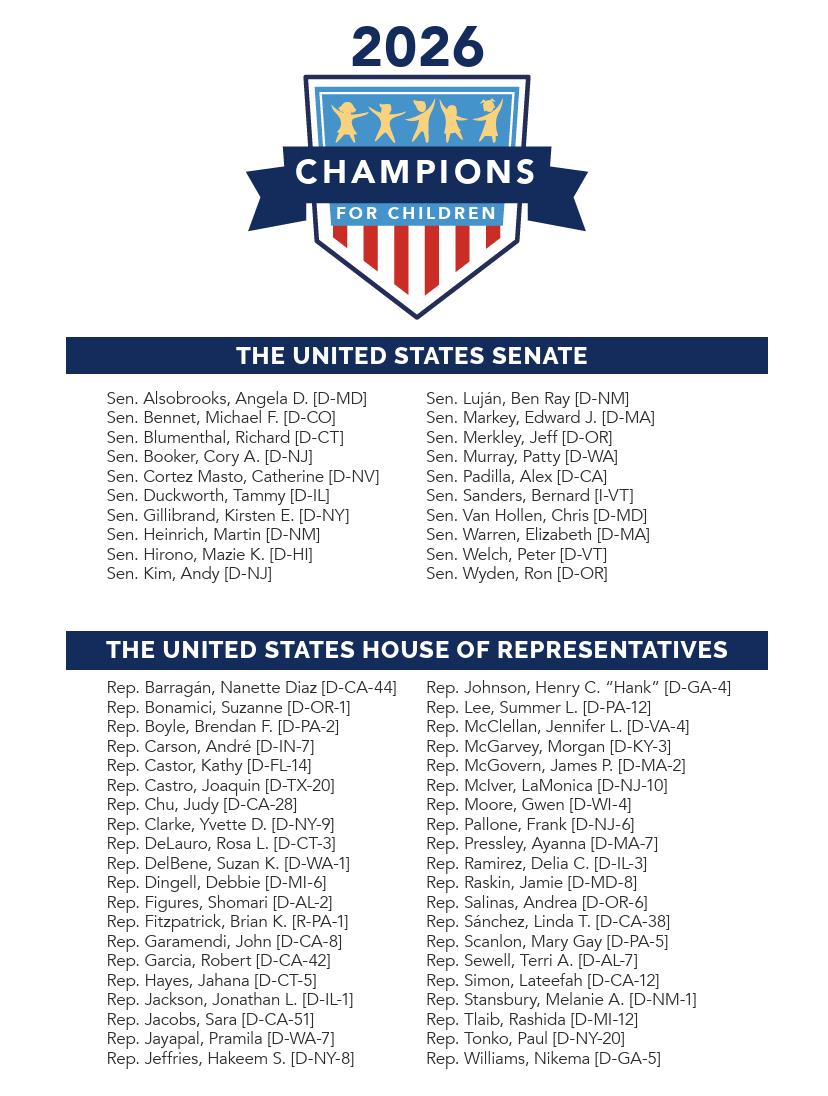
This year’s Scorecard recognizes 120 Champions and Defenders of Children — 60 Champions and 60 Defenders, 40 senators and 80 representatives — who repeatedly used their voices, votes, and leadership to put kids first. In a Congress where children were too often treated as an afterthought, or worse, as a target, these members made children a first focus.
As always, the Scorecard is about two things: accountability and gratitude.
It is meant to thank those who lead for children, to encourage others to do more, and to insist that every member of Congress take their obligation to the next generation seriously. And with the midterm elections less than a month away, it is also something more: a record voters can use to decide who has earned the right to keep representing their children.
A Congress That Failed Children
Let us be blunt. The 119th Congress did not treat children as a national priority.
The share of the federal budget devoted to children has fallen from 12.16% in fiscal year 2022 to just 8.43% in FY 2026 – a more than 30% reduction.
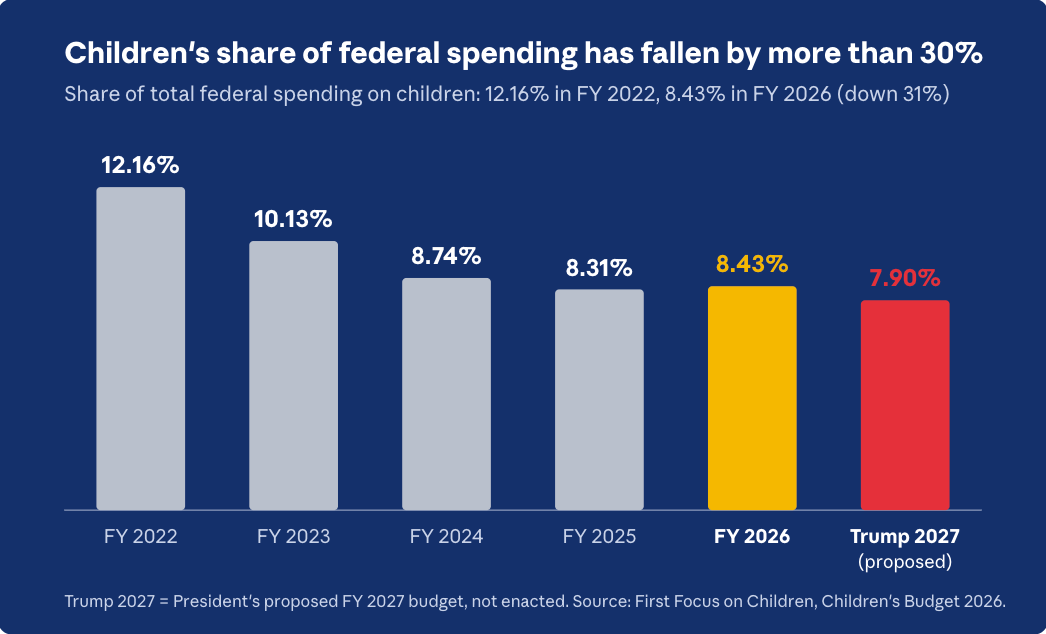
Instead of reversing that decline, congressional leadership and President Trump enacted legislation last year that slashed Medicaid and SNAP — two of the most important lifelines for children — and moved to weaken or dismantle the Department of Education, the Department of Health and Human Services (HHS), the U.S. Agency for International Development (USAID), and other agencies that exist to serve and protect young people.
The roll call votes tell the story.
Over the full Congress, we scored 21 child-centered recorded votes (the Scorecard does not include voice votes). Setting aside one where our position was mixed, kids lost 19 of 20.
Many of those losses came down to a handful of votes. For example:
The House passed the Rescissions Act of 2025, clawing back global health and humanitarian aid, by two votes, 214–212.
Sen. Ron Wyden’s (D-OR) amendment to strike the budget instruction calling for $880 billion in Medicaid cuts failed 49–50.
Sen. Susan Collins’s (R-ME) amendment to protect nearly $295 million for UNICEF was tabled 51–47.
Sen. Mazie Hirono’s (D-HI) amendment to strike a private school voucher scheme failed on a 50–50 tie.
Sen. Chris Van Hollen’s (D-MD) school meals amendment failed 48–50, and Sen. Angela Alsobrooks’s (D-MD) amendment to increase child care funding for families failed 47–51.
Meanwhile, House and Senate members introduced at least half a dozen bills and constitutional amendments to end birthright citizenship, a constitutional amendment on so-called “parental rights,” and bills to abolish the Department of Education outright.
The lone recorded vote victory for kids came when the House voted 280–142 for Rep. Anna Paulina Luna’s (R-FL) amendment to strip a liability shield for pesticide manufacturers, a bipartisan vote for children’s environmental health. But note: even that vote was only to maintain the status quo and keep things from getting even worse for kids.
Just 1 win in 20. This was not just a Congress of missed opportunities. It was a Congress that repeatedly made choices that left children poorer, sicker, and less secure.
That is precisely why the members who stood up anyway deserve our special thanks.
The Good News: A Roadmap Already Exists
The Scorecard isn’t only a record of what Congress did. It also highlights more than 250 bills that Congress could act on right now to improve the lives of children, the vast majority of which we support.
Over 70 of those had strong bipartisan support, but the vast majority of those were never brought to the House or Senate floor for consideration. For example, members of both parties have introduced legislation to improve the Child Tax Credit, improve children’s health coverage, address our maternal health crisis, make child care more affordable, reduce child hunger, protect the children of immigrants, and keep kids safe online and in school.
Kids don’t necessarily need Congress to invent new ideas. There already were a raft of bills in which there was common ground on bipartisan solutions for children. They just needed congressional leadership to bring the good ones to the floor and for members to “vote for kids.”
The 119th Congress stands out as a Congress where that rarely happened. Child policy regressed far more than it advanced. This was a choice, and it needs to change.
Who Gets Recognized as Champions/Defenders
Fortunately, there were some important voices for good in Congress. The Scorecard draws a small distinction between our two honors:
Champions for Children consistently pursued policies that put children first across a broad range of issues. If we were assigning grades, these members would get an A+.
Defenders of Children repeatedly stepped forward to protect children from harm and to support their well-being when it mattered most. They would earn an A or A-.
Their work spans the full array of children’s issues: health, nutrition, child poverty, early childhood, education, child welfare, safety, immigration, and international policy. To name some examples:
Sen. Cory Booker (D-NJ) and Rep. Rashida Tlaib (D-MI) stood out in the Senate and House, respectively, as the top point-getters in the session’s Scorecard by their work across the full range of issues of importance to children.


Sen. Michael Bennet (D-CO) and Reps. Rosa DeLauro (D-CT) and Suzan DelBene (D-WA) led the American Family Act to restore a fully refundable Child Tax Credit.
Sen. Andy Kim (D-NJ) introduced the MediKids Act to guarantee health coverage for every child.
Reps. Morgan McGarvey (D-KY), Rosa DeLauro (D-CT), Jimmy Gomez (D-CA), Sara Jacobs (D-CA), and Rashida Tlaib (D-MI) and Sens. Ed Markey (D-MA), Ben Ray Luján (D-NM), Adam Schiff (D-CA), Chris Van Hollen (D-MD), and Elizabeth Warren (D-MA) introduced the Child Safety and Well-Being Act of 2026 to create an independent Children’s Commission, an institution in Washington whose job is to ask whether federal policy is good for children.
Rep. Bobby Scott (D-VA), Rep. Katherine Clark (D-MA), and Sen. Patty Murray (D-WA) led the Child Care for Working Families Act.
Rep. Nanette Barragán (D-CA) introduced the Children’s Health Insurance Program Permanency (CHIPP) Act.
Sens. Catherine Cortez Masto (D-NV), Bill Cassidy (R-LA), Ron Wyden (D-OR), and Susan Collins (R-ME) and Reps. Danny Davis (D-IL) and Brian Fitzpatrick (R-PA) introduced the SSI Savings Penalty Elimination Act.
Sens. Ed Markey (D-MA) and Bill Cassidy (R-LA) spearheaded the Children and Teens’ Online Privacy Protection Act (COPPA).
Children Are a Bipartisan Cause, Or At Least They Should Be
The Scorecard calls balls and strikes. Members earn points for sponsoring, cosponsoring, and voting for legislation that primarily or disproportionately affects children, and lose points for supporting legislation that harms them. Although Democrats make up the majority in this year’s Scorecard, every year, Republicans have earned recognition, and 2026 is no exception.
Before proceeding with that list, it is important to note that more Republicans would have been named if House and Senate leadership had chosen to bring more bipartisan pro-child bills to the floor rather than a slew of bills that were harmful. Those negative votes against children disproportionately hurt Republican members in the last two years. Again, this was a choice.
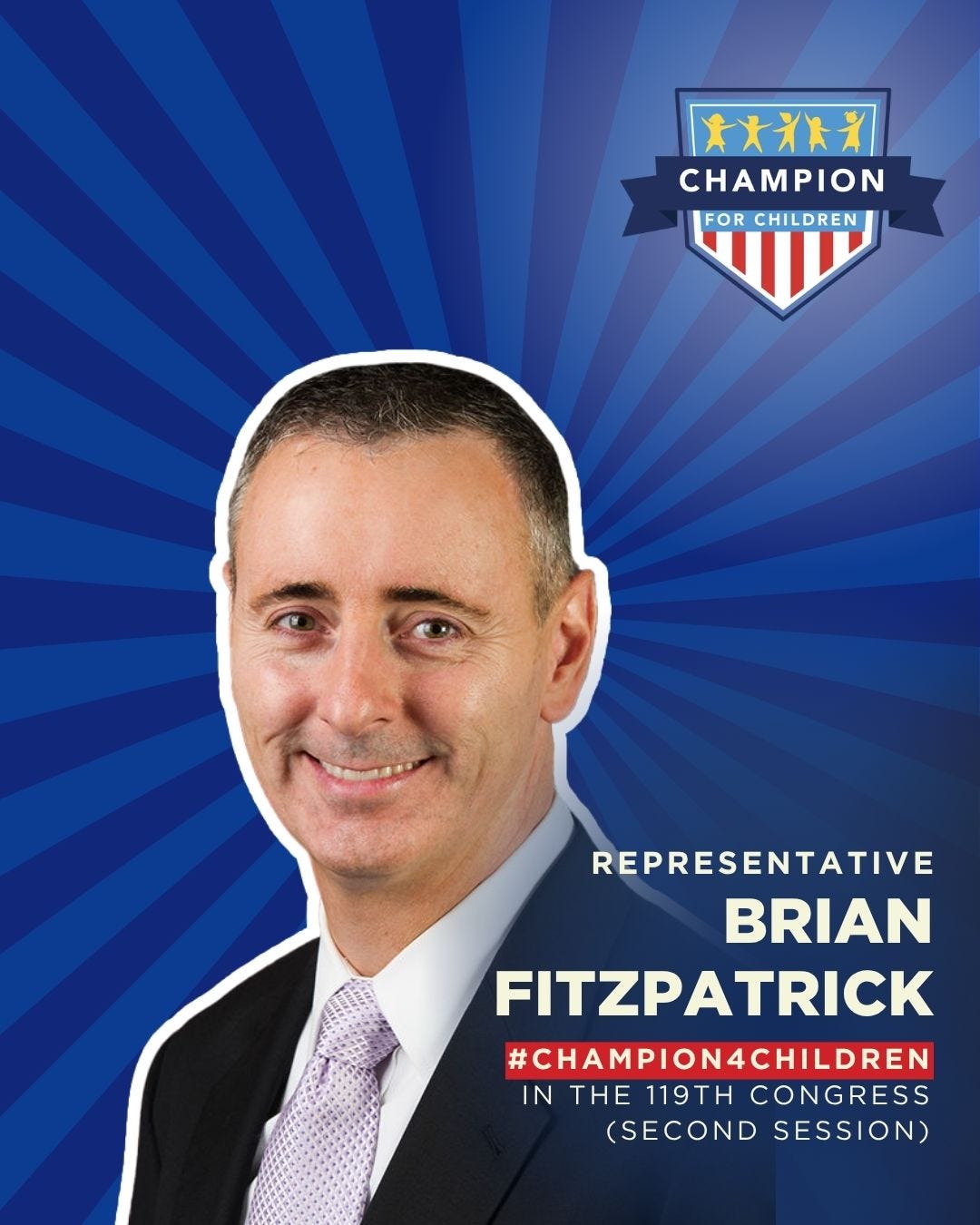
Yet, Rep. Brian Fitzpatrick (R-PA), once again the highest-scoring Republican, is a 2026 Champion for Children. He co-led the MODERN WIC Act with Rep. Suzanne Bonamici (D-OR), the Kids’ Access to Primary Care Act with Reps. Kim Schrier (D-WA) and Kathy Castor (D-FL), the Fairness to Kids with Cancer Act, the Mental Health Services for Students Act, and the Global Child Thrive Reauthorization Act, among others. He repeatedly chose to champion the needs and best interests of children in his work in the halls of Congress.
Sens. Susan Collins (R-ME) and Lisa Murkowski (R-AK) and Reps. Mike Lawler (R-NY) and María Elvira Salazar (R-FL) were also honored in the Scorecard. As an example, Sen. Collins joined Democratic appropriators and honorees like Rep. Rosa DeLauro (D-CT) and Sen. Patty Murray (D-WA) to protect many children’s programs from substantial cuts proposed by the President’s budget.
Children desperately need far more of this bipartisan engagement on their behalf. Kids are not a partisan issue, and they should never be a political bargaining chip.
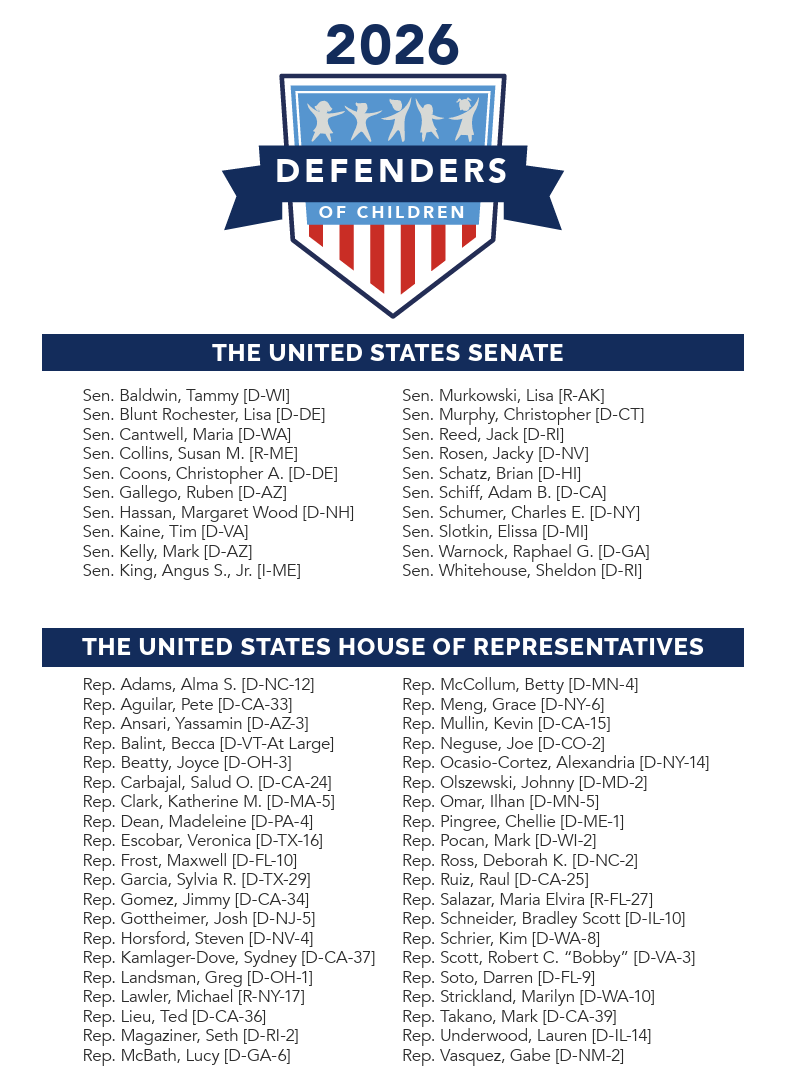
To be clear, many members of Congress who are not on these Champions and Defenders lists took meaningful actions for kids, including behind-the-scenes work that is hard to score. We see them, and we are also grateful to them as well.
Women Continue to Carry the Load
As in every year, one of the most striking findings is the gender divide.
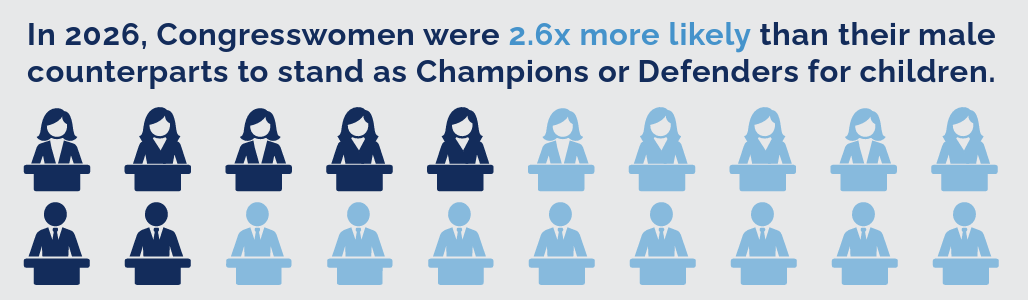
Women in Congress were 2.6 times more likely than men to be Champions or Defenders of Children. More than 39% of women in Congress earned the distinction. And women made up exactly half of the 120 honorees, despite holding just 28.8% of the seats in Congress.
The Congressional Mamas’ Caucus stands out even among high-performing women: its members were 2.6 times more likely to be Champions or Defenders than women outside the caucus.
Men Must Do Better by Children, but the Dads Caucus Is Stepping Up
In February, we wrote that the creation of the Congressional Dads Caucus was one of the most encouraging developments for kids in Congress. The full-Congress data makes the case even stronger. Men in the Dads Caucus were 5.7 times more likely to be Champions or Defenders than men outside it, up from 3.8 times in our first-session report.
Clearly, when men organize around fatherhood, children stop being “soft” issues and start becoming a priority. Kids don’t need men in Congress to be perfect. Just as members of the Dads Caucus are doing, children need more men to show up.
Where Kids Have Allies, and Where They Don’t
Map the Champions and Defenders, and a familiar story emerges: a child’s zip code shapes whether their members of Congress treat them as a priority.
Northeast: 40.4% (44 of 107 members)
West: 35.9% (33 of 91)
Midwest: 17.0% (17 of 98)
Southeast: 11.7% (16 of 135)
Southwest/Plains: 11.5% (12 of 103)
As Bruce wrote this summer, the South is the only region of the country where the child population is still growing, and it is also the region with the worst outcomes for kids and the fewest leaders willing to fight for them.
The lowest-scoring members of Congress reinforce that pattern. Sens. Marsha Blackburn (TN), Cynthia Lummis (WY), Bernie Moreno (OH), Eric Schmitt (MO), and Rand Paul (KY), along with Reps. Ralph Norman (SC), Ben Cline (VA), Mary Miller (IL), John Rose (TN), Greg Steube (FL), Brandon Gill (TX), Andy Biggs (AZ), and Andy Ogles (TN). These members repeatedly sponsored, cosponsored, and voted for legislation that would cut children off from health care, take food from hungry kids, undermine public schools, and strip away the protections of citizenship.
If they simply asked themselves, “Is it good for children?”, they would have had to recognize that the answer was a resounding NO.
Consider Texas. It ranks 44th in child well-being in the 2026 KIDS COUNT Data Book, yet just three members of its delegation, Reps. Joaquin Castro, Veronica Escobar, and Sylvia Garcia, are Champions or Defenders. Thank you to all three, but they represent just 7.5% of the Texas delegation. Children desperately need Texas voters to send more pro-child congressional members to Capitol Hill to join Reps. Castro, Escobar, and Garcia.
In sharp contrast, Massachusetts ranks 2nd in the child well-being index, and five of its members, or 45% of the delegation (6 times more likely to be a Champion/Defender than the Texas delegation), are recognized as Champions or Defenders. Thanks to Sens. Ed Markey and Elizabeth Warren and Reps. Jim McGovern, Ayanna Pressley, and Katherine Clark for their strong support of children. Massachusetts invests in its children, and its voters send policymakers to Congress that reflect that commitment to kids.
The link to child well-being holds more broadly in states all across the country. It should come as no surprise that in the 25 states ranked “best” or “better” for kids by KIDS COUNT, 28.6% of the congressional delegation were Champions or Defenders. In the 25 states ranked “worse” or “worst,” it was just 18.6%.
We should not overstate this. It isn’t a randomized experiment. But it points to something families already know: politics is part of the ecosystem that determines whether children thrive. Communities that prioritize children elect leaders who act like it, and leaders who prioritize children help build communities where kids do better.
We need to build more favorable social and political environments for children in many places across this country, but particularly in the Southeast, Southwest, and the Plains. Voters can make direct some of those decisions when they go the polls to elect for every member of the House on Election Day: Tuesday, November 3.
Why Gratitude Matters
If children had a vote, if toddlers had a PAC, if fourth-graders could flood Capitol Hill with lobbyists and campaign checks, we wouldn’t need a Scorecard to remind Congress that kids deserve attention.
But children don’t have those tools. So, we use the ones we do have.
Public gratitude is a form of political power. It tells lawmakers that showing up for kids isn’t invisible. It tells their staff that child-focused work is valued. And it signals to every other member of Congress that there is credibility and momentum on the side of putting kids first.
To our 2026 Champions and Defenders of Children: we are deeply appreciative. You made children a priority.
To those at the bottom of the list, we simply say, “DO BETTER.”
What You Can Do
Take five minutes today to look up your senators and representative in the Scorecard.
If they’re a Champion or Defender of Children: Call their office and say thank you. Post on social media. Mention it at a town hall. Their support for kids should be recognized. Public reinforcement creates the incentive structure children cannot create for themselves.
If they’re not on the list: Ask them why not, and ask them which of the hundreds of positive bills for children in the Scorecard they will commit to supporting in the next Congress.
When you are voting this fall: Every candidate should have to answer this one simple question: “Is it good for the children?” When you look at their records, see whether their actions match their answer and whether they make children a priority in their work.
Kids can’t vote. But you can.
#VoteKids