

What the Washington Post Gets Wrong About MediKids
A response to the Washington Post's editorial against covering every child and the question the Post’s editorial board seems shockingly unconcerned about: what happens to the kids left uncovered?

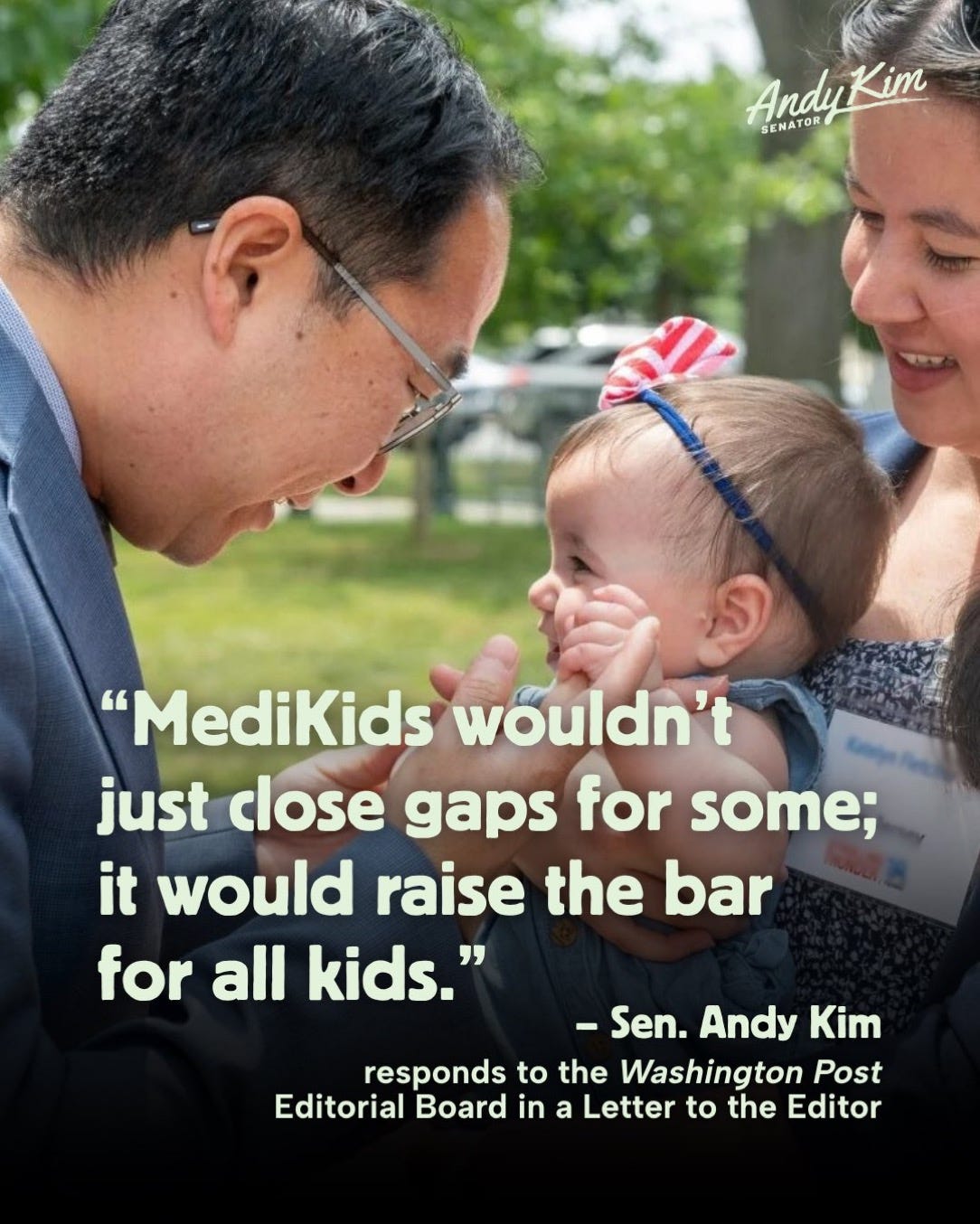
There are about 4.4 million kids without insurance and about 23 million underinsured in our country. That’s unacceptable and why I introduced MediKids to cover every kid until they turn 26.
– Sen. Andy Kim, Yes, Medicaid Should Cover All Kids, Washington Post, Jul. 30, 2026
Thirty-five years ago, a bipartisan commission created by Congress and President Ronald Reagan — chaired by Sen. Jay Rockefeller (WV) and stocked with members appointed by President Reagan, the Senate, and the House — sat down for two and a half years and asked what America owed its children.
Their answer, delivered in June 1991 as a report entitled Beyond Rhetoric: A New American Agenda for Children and Families, called on the country to stop treating children’s well-being as an afterthought and to build the health coverage, income security, and family supports that would let every child in America grow up healthy, educated, and safe.
Health coverage for every child wasn’t a partisan aspiration then. It was the majority finding of a bipartisan commission built specifically so that neither party could own — or dismiss — the answer.
Here is what the National Commission said:
Good health is essential to children’s growth and development and to their future prospects. While most American children are born and remain healthy, far too many are vulnerable to problems that lead to serious illness, disability, and even death. This country has the knowledge and the tools to save children’s lives and improve their physical and mental health. Yet in recent decades, the nation’s progress in improving child health has not kept pace…
Today, we face a new crisis, as the rate of uninsured children is rising. Sen. Andy Kim (NJ) has stepped up to meet this modern-day challenge.
As background, after the National Commission on Children's report, the nation began to make significant progress on children’s health coverage with the passage of the Children’s Health Insurance Program (CHIP) in 1997. According to the Urban Institute, between 1997 and 2015, the uninsured rate for children dropped from around 15% to 4.8%.
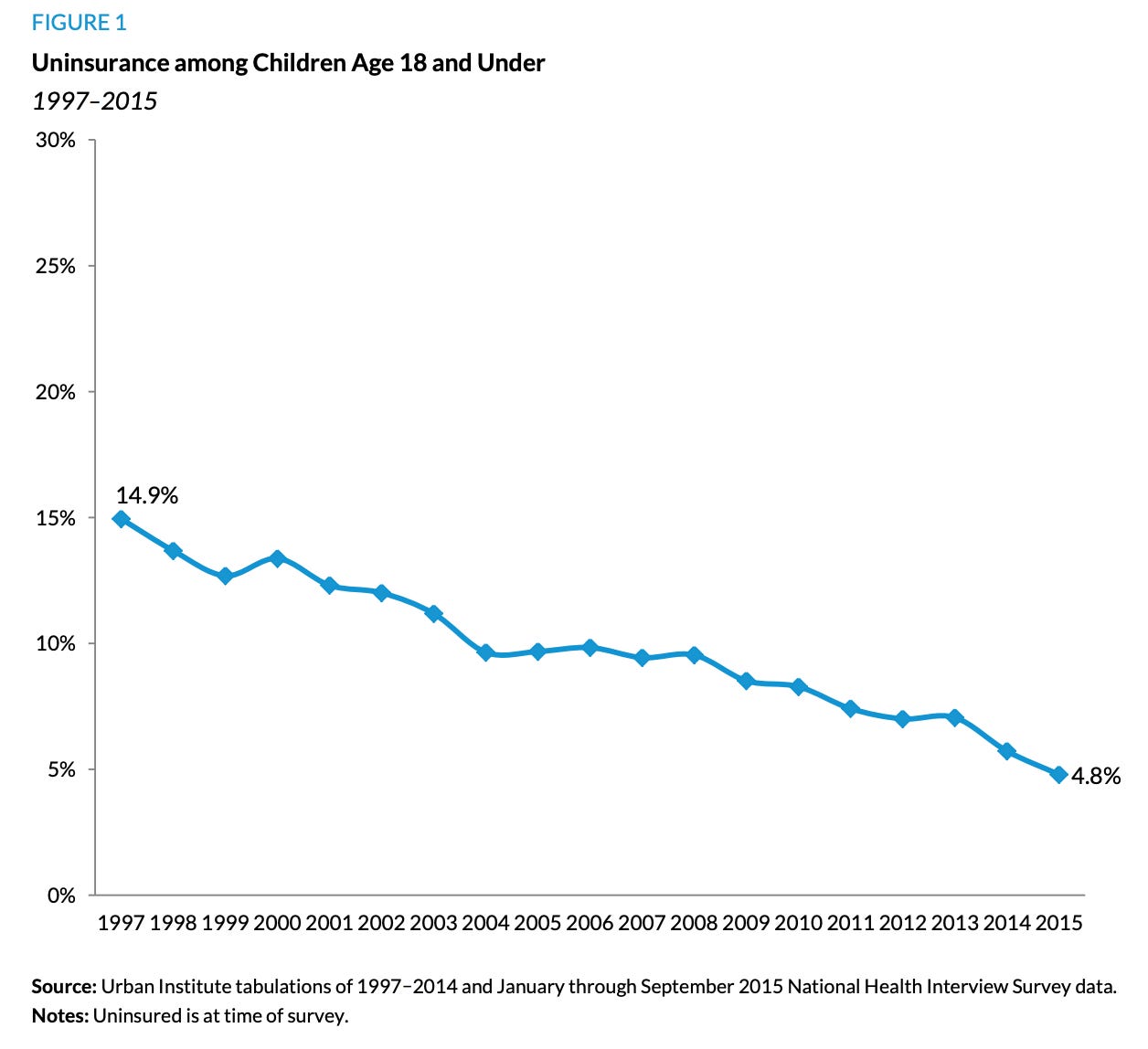
Unfortunately, progress stalled in 2016 and has since grown to 6.1%, which, according to the U.S. Census Bureau, is nearly a 30% increase from its historic low.
That reversal is poised to get much worse.
In just the last year and a half, the Georgetown Center for Children and Families (CCF) has tracked over 2 million fewer children enrolled in Medicaid.
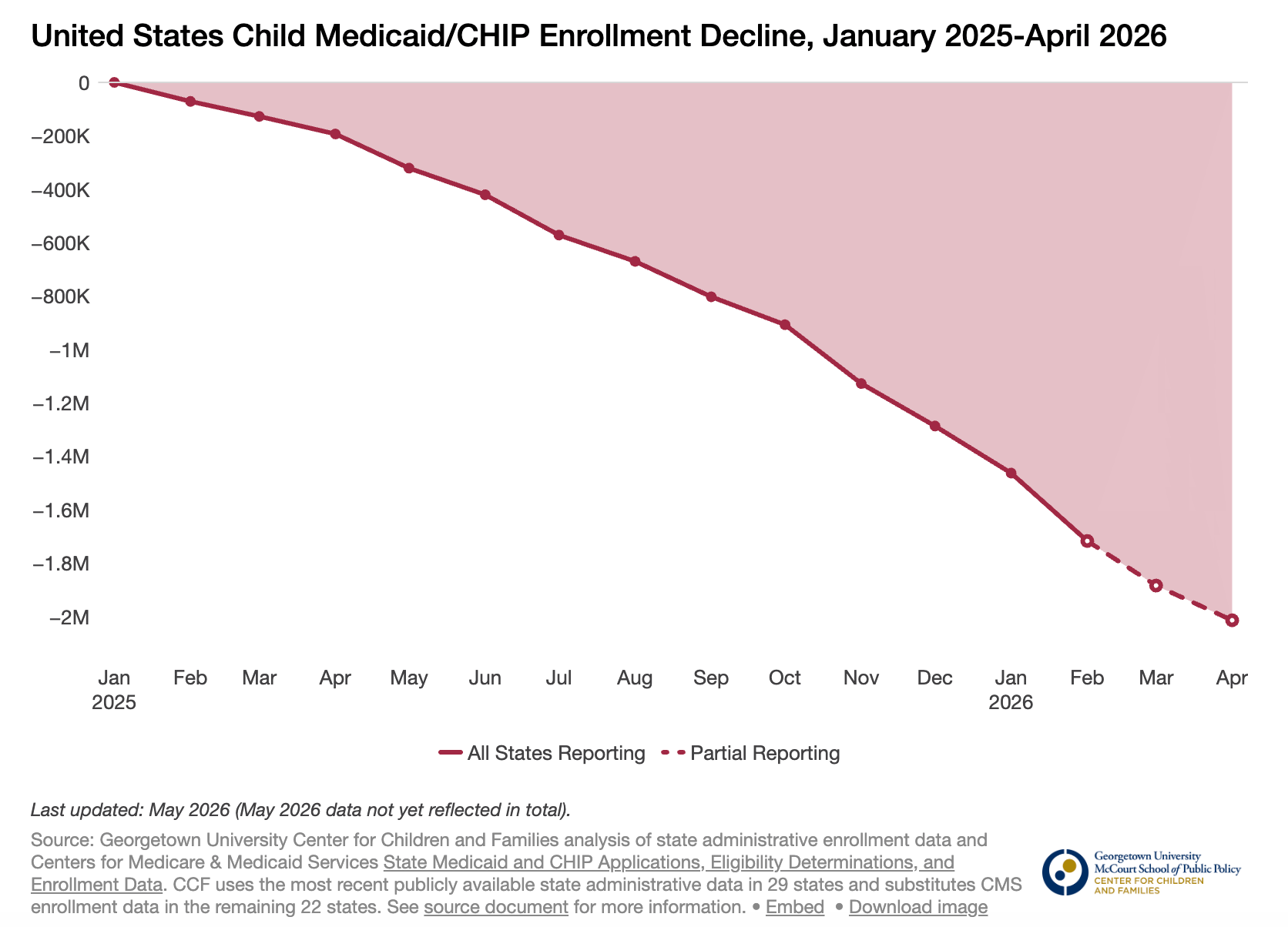
Consequently, the uninsured rate of children is already rising, even before the vast majority of the more than $900 billion in Medicaid and CHIP cuts enacted last year as part of the so-called “One Big Beautiful Bill (OBBB) fully take effect.
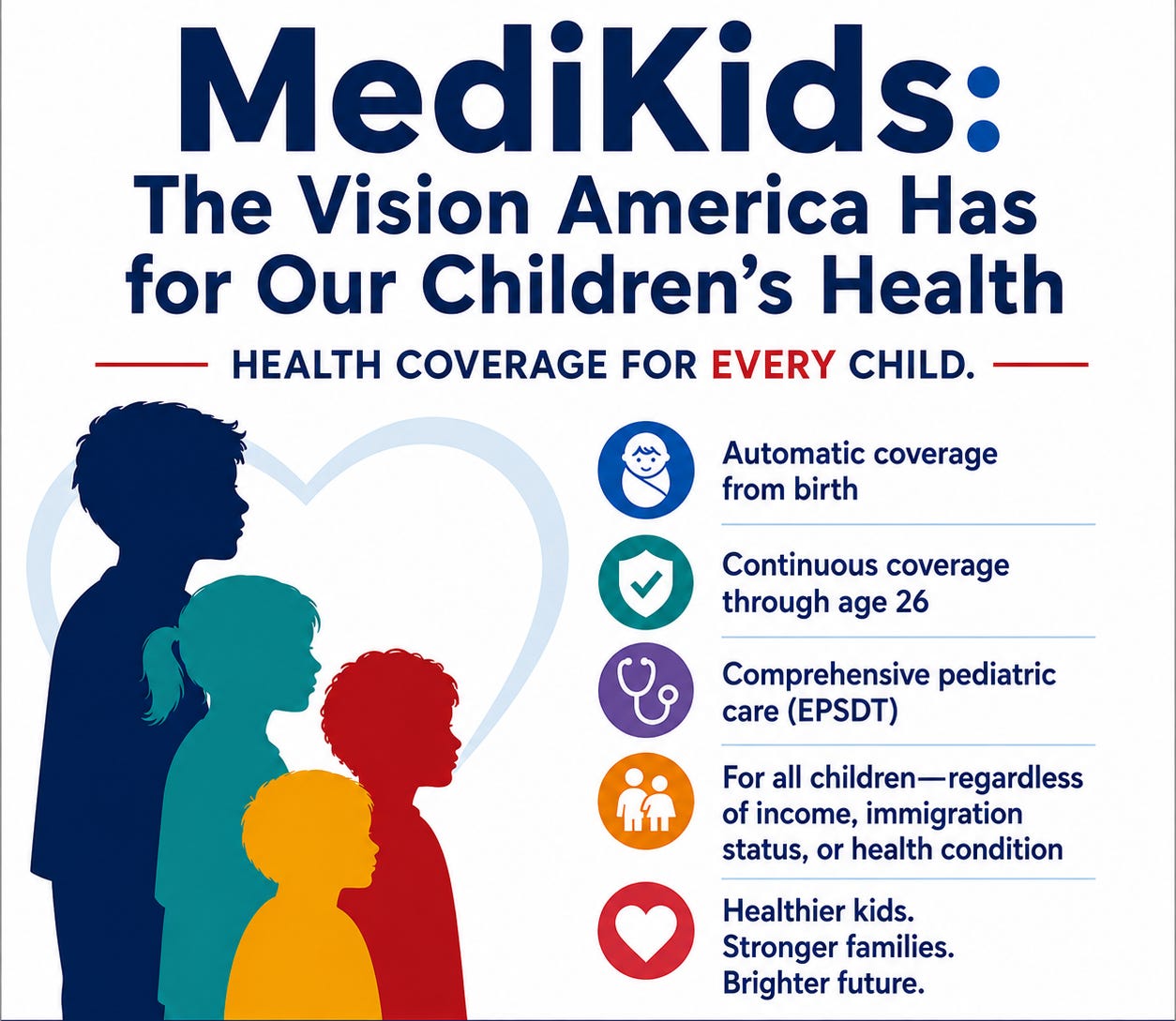
In the face of this worsening crisis, Sens. Kim (NJ), Tammy Duckworth (IL), Cory Booker (NJ), and Alex Padilla (CA) introduced MediKids (S. 5037) to get the nation back on the right track toward the goal of covering all kids.
Unfortunately, the Washington Post editorial board reviewed their proposal to eliminate that gap and shockingly missed the entire point.
What The Post Actually Objects To
MediKids would automatically default newborns into coverage through Medicaid, with an opt-out for families who have and want private coverage instead – just as the default for seniors is Medicare coverage with a similar opt-out.
The biggest failure of the Washington Post’s editorial is that it fails to acknowledge the enormous benefits to children in ensuring that all have access to health coverage.
As the National Commission on Children wrote decades ago but is still true today:
Many American children go without health care simply because of their family’s income, because of where their parents are employed, or because of where they live.
The Washington Post’s misguided critique also rests on a handful of claims that repeatedly ignore the needs and best interests of children, as if kids do not merit actual attention and focus on their health and well-being.
Analysis of the Washington Post’s criticism of MediKids
First, the Washington Post’s editorial board treats the absence of a means test in MediKids as somehow self-evidently disqualifying. But universality is not a bug in program design – it is the point.
Medicare, for example, has proven durable, popular, and hard to gut because it its universality. Every senior citizen has a stake in it.
In contrast, a means-tested children’s benefit has always been one election away from being labeled “welfare” and cut, just as happened just over one year ago when President Trump and Congress slashed Medicaid by more than $900 billion through OBBB.
Here is what was not cut in OBBB: Medicare.
Second, the Washington Post predicts that “employers will drop dependent coverage” if MediKids were to pass, as if employers have not been dramatically cutting children’s coverage already. KFF’s 2025 Employer Health Benefits Survey found workers pay an average of $1,440 out of pocket annually to add themselves to a plan — and $6,850 to cover their family, with that jumping to $8,889 at small firms (10-199 workers). In small firms, 59% offer health coverage, and among those firms, 29% do not subsidize dependent coverage.
As Sen. Kim has pointed out, in addition to the 4.4 million uninsured children, there are an estimated 23 million underinsured.
Beyond the costs, research on both Affordable Care Act (ACA) Marketplace and employer-sponsored plans has repeatedly found narrower networks for pediatric specialists than for adult ones, and children’s hospitals report that pediatric subspecialty shortages now mean waits of 13 weeks or more for some appointments.
If employer coverage for dependents is increasingly unavailable, unaffordable, under-networked, and increasingly hard to access, offering a public guarantee that has no eligibility cliffs and no paperwork churn isn’t a downside — it’s a fix.
Third, the Post’s editorial board wrongly tries to compare a U.S. children’s Medicaid guarantee to the UK’s National Health Service (NHS) plan. The fact is that nothing in MediKids nationalizes hospitals, sets global budgets, or rations care by wait time.
Instead, MediKids expands eligibility for Medicaid, a public-private partnership with a benefit structure – Early and Periodic Screening, Diagnostic, and Treatment (EPSDT) – built specifically to address pediatric health services, pediatric developmental needs, and provider networks.
As Sen. Kim explained in his letter-to-the-editor to the Washington Post:
Kids need different health care than adults. Medicaid, through the Early and Periodic Screening, Diagnostic, and Treatment benefit, focuses on preventive care — requiring routine screenings and then providing the physical and mental health care, including dental, hearing and vision services, needed to address any issues. This comprehensive care is the gold standard for children’s health coverage. MediKids is also a smart investment. It is estimated that for every dollar spent on children’s health, the government saves $4 in future costs.
Medicaid recognizes that children are “not little adults” so its design is, as Sen. Kim notes, “specifically designed for kids in ways that employer-based health care programs, even top-of-the-line plans held by wealthy families, are not.”
Medicaid is pediatric-focused and kid-centric.
Rather than the Washington Post’s false attempt to compare Medicaid to the UK’s health care system, the real comparison is Medicare, which has focused on covering every American who is 65-and-older for the last 61 years. Medicare just celebrated its 61st birthday and hasn’t collapsed into rationed, NHS-style care that the Washington Post’s editorial argues “always happens.”
Instead, Medicare is popular and delivers coverage to tens of millions of people every year. If universal, uncapped public coverage “always“ leads to collapse, The Washington Post should explain why Medicare is as popular and strong as it is today – some 61 years after it was created.
Fourth, the Post argues that Sen. Kim “does not know how much his idea would cost,” as if that is some kind of gotcha. Instead, all it reveals is that the Post doesn’t seem to know how Congress actually works.
The reality is that bills are introduced, support is built, cosponsors are added, and public attention grows long before the vast majority of bills are formally teed up for Congressional Budget Office (CBO) scoring. That has been the case with nearly every major piece of legislation in American history. Treating an absent score as disqualifying at the introduction stage would mean no bill could ever be introduced at all. If that were the standard, nothing new could ever get proposed to improve the lives and well-being of children.
While I often criticize the media for reporting on children’s issues almost entirely through an adult lens, this is ridiculous even for the Washington Post’s new editorial board.
Furthermore, the Post’s own numbers in the editorial inadvertently demonstrate that children are the cheapest population to cover. As even the Post unwittingly acknowledges, just 16% of all Medicaid spending is on children, despite the fact that children are nearly half of all Medicaid enrollees.
Although the Washington Post did not seem to intend to make this point, the editorial effectively highlighted the fact that kids are the least expensive population to cover.
Fifth, the Post’s editorial board cites the problem that “children are struggling to obtain care, due in part to bureaucratic hurdles and paperwork problems” in Medicaid. That is, of course, due to the fact that Medicaid is means-tested, which, by definition, establishes income-related eligibility barriers to coverage. OBBB has further complicated the problem by imposing massive new paperwork and bureaucratic barriers to coverage.
Once again, The Post is unintentionally making Sen. Kim’s point, as MediKids would explicitly eliminate these bureaucratic and red tape “denial by design” barriers to coverage for children.
That is the very point of his legislation and precisely how it aspires to achieve the National Commission on Children’s call to cover all kids.
Here Sen. Kim explains the design of MediKids in a conversation with renowned historian Heather Cox Richardson.
What The Post Fails to Address
After two decades of significant progress in cutting the uninsured rate for children after the passage of CHIP in 1997, the uninsured rate for children is heading in the wrong direction. To prevent ever-worsening rates of uninsured children, change is desperately needed to set children back on the right pathway to ensuring all kids are covered. That is what MediKids would do.
Instead, the Post’s editorial board argues for nothing other than the status quo.
Even worse, at no point does the editorial affirm that every child in America having health coverage is a goal worth pursuing. It criticizes the mechanism, the cost, the eligibility design, the politics — but it never says “yes, and here’s how we’d get there instead.”
That omission is a real tragedy and lets the Post skip past what is actually at stake here: the health and well-being of our children and grandchildren. For a child, being uninsured isn’t simply an inconvenience. The evidence demonstrates that it can lead to tragic health outcomes.
Uninsured children are less likely to have a usual source of care, less likely to get preventive visits and immunizations, more likely to have conditions go undiagnosed and untreated, and more likely to end up in the emergency room for problems that should have been caught earlier. Delayed diagnoses become worse diagnoses. In the most serious cases, kids who don’t get care in time don’t just get sicker — they die from causes that were preventable.
An editorial that spends its full length litigating income caps and CBO scores without once weighing the cost to kids fails to ask the only question that actually matters: is it good for children?
The Washington Post is certainly entitled to answer Sen. Kim’s proposal with a “not this vehicle.” However, it fails all children by skipping past the question of what happens to the kids left uncovered by its embrace of the status quo, which is effectively an embrace of rising rates of uninsured and under-insured children and worsening health outcomes.
For kids, nearly two generations have already waited for an answer to the call for health coverage for all children that the National Commission on Children issued back in 1991.
It’s been 35 years, and our kids can’t wait any longer. Rather than simply adopting defensive measures to make the trillion-dollar cuts “not so bad,” we should aspire to something much better for our children: MediKids.
While we can certainly quibble over the type of vehicle we should take, it is past time to change the debate and policy choice back toward making progress for our children and grandchildren.
Thanks to Sen. Kim and his Senate colleagues, MediKids would put the nation back on the right path to cover all kids.
Kids can’t wait.
What You Can Do
If you would like to join the effort to support MediKids, here are some things you can do:
Call or write your senators and ask them to cosponsor S. 3507, the MediKids Act, by Sen. Andy Kim (NJ).
Subscribe to this newsletter to get updates and more information on how public policy issues are impacting our children.
Join us as an Ambassador for Children.