


If you set out to embarrass a Kennedy, you could hardly script a better run than the one Robert F. Kennedy Jr. has endured as a member of the Trump Administration, as its Secretary of Health and Human Services.
What I am referring to is the remarkable destruction of the Kennedy family legacy taking place across the Administration over the last 22 months.
As a child, my three favorite presidents in our history were Abraham Lincoln, Franklin Delano Roosevelt, and John F. Kennedy. In JFK’s case, it wasn’t so much the allure of Camelot but the ideas and belief that public service could be an expression of optimism – a “New Frontier”, as he put it, where government and citizens could accomplish important things together.
Today the Kennedy legacy is sometimes associated with places, such as the John F. Kennedy Presidential Library and Museum, the Kennedy Center, the White House Rose Garden, and the eternal flame at Arlington Cemetery. But the family’s greatest successes were not made of marble or stone, but of the programs, institutions, vision, and hope brought to the country and to people around the world.
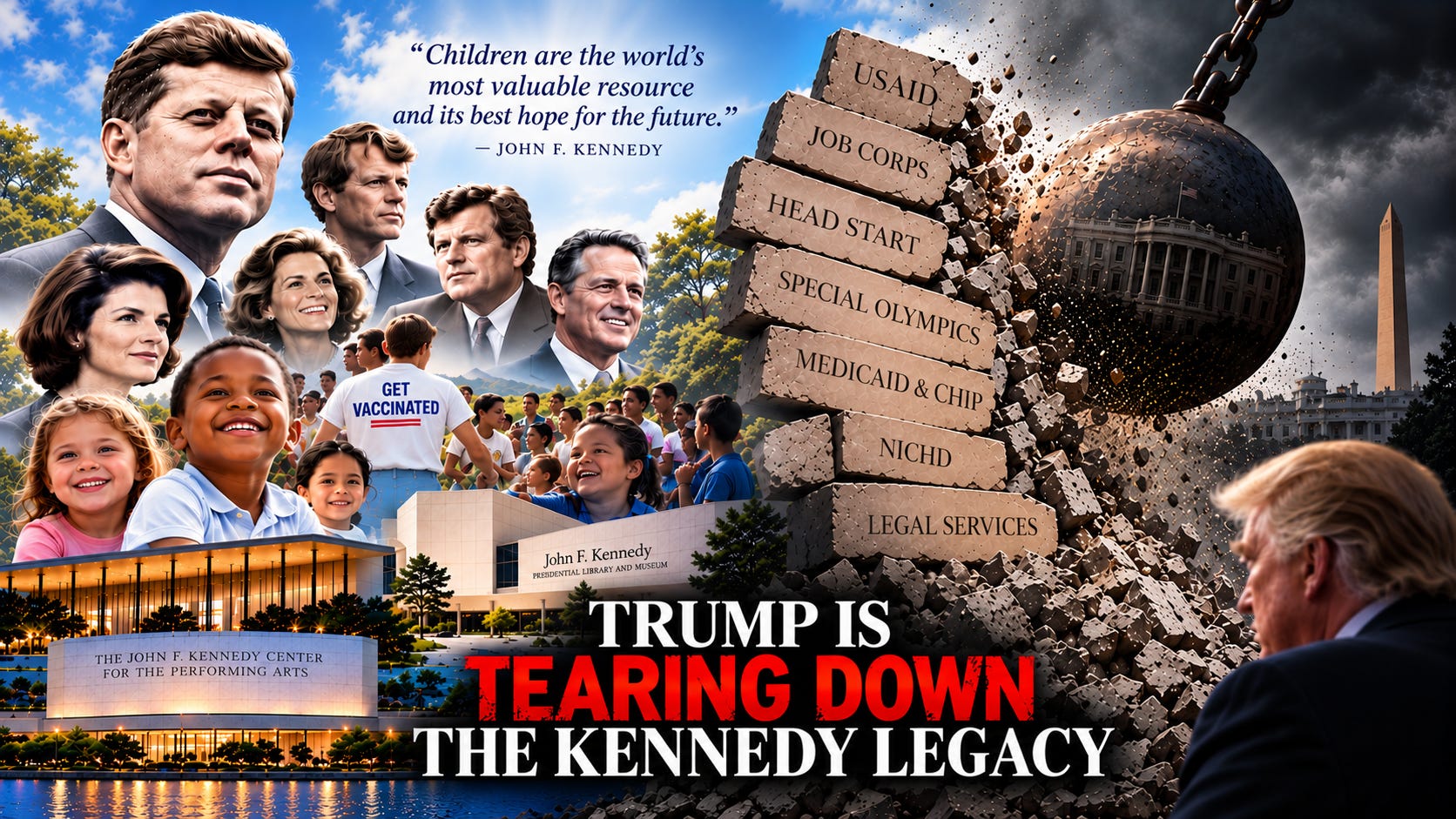
There were institutions built around a particular idea of America: that government could summon people to serve something larger than themselves, that poverty should not determine a child’s future, that people with disabilities deserve dignity and opportunity, that health care is a fundamental right, that science should improve human lives, that justice should not depend on whether someone can afford a lawyer, and that America’s responsibility is global.
This legacy is one of family – belonging to JFK but also his brothers Robert F. Kennedy and Ted Kennedy, Eunice Kennedy Shriver and Sargent Shriver, Jacqueline Kennedy, and others who turned a famous family into institutions that have endured for generations.
This is one of the least discussed and most disturbing features of the Trump Administration: it seems to have targeted the Kennedy legacy directly. One by one, an extraordinary number of those institutions have been eliminated, cut, threatened, transformed, or diminished.
The Trump Administration’s first term targeted Special Olympics, a program founded by JFK’s sister Eunice. In the current term, the first target was the foreign aid agency President John F. Kennedy created: the U.S. Agency for International Development (USAID). Next came the memorial to JFK, now shuttered and under threat of demolition because a court won’t let Trump put his own name on it. Head Start, the program JFK’s brother-in-law launched, is being hollowed out by a rule written inside the very department Kennedy runs. Medicaid and CHIP, legacy items of JFK’s brother Ted, are being gutted with RFK Jr. at the helm. And even the MAHA movement RFK Jr. built has been turned into a corporate trade show.
Maybe it’s a coincidence. Maybe it’s just Trump being Trump. But taken together, it looks a lot like the President has gone out of his way to destroy the Kennedy legacy and even troll his Health Secretary.
Even Jackie Kennedy’s Rose Garden is gone.
The Monuments We Can See
“I look forward to an America which will not be afraid of grace and beauty. . . .”
— President John F. Kennedy, Amherst College, October 26, 1963
Although the Rose Garden may seem trivial compared to some of the other issues I will raise here, for more than six decades, its central lawn provided the setting for presidential announcements, bill signings, ceremonies, diplomatic events, and moments of national celebration and mourning.
Throwing aside that history, the Trump Administration replaced the Rose Garden with a Mar-a-Lago style patio of cement and stone paving. While a garden and lawn can be replanted, what is lost will be much harder to restore.
Even worse is the destruction of the John F. Kennedy Center for the Performing Arts. Trump removed members of its board, appointed himself chairman, and presided over a fundamental change in the direction of the institution created by Congress as the nation’s living memorial to John F. Kennedy. Trump pushed to rename it the “Trump-Kennedy Center” and bolted his name onto the building.
U.S. District Judge Christopher Cooper ruled that only Congress can change its name. The Trump-appointed Board tried again with a “President Donald J. Trump Plaza” out front, which Judge Cooper blocked as well.


Today the Kennedy Center is closed, and the President is threatening its outright destruction.
Even the John F. Kennedy Presidential Library and Museum was not immune. Federal workforce reductions in February 2025 as part of Elon Musk’s DOGE eliminated most of visitor-services staff, which forced the Presidential Library to abruptly close and announce its indefinite shutdown.

After public outcry, the National Archives reversed course and reopened the library.
As for RFK Jr., it’s hard to imagine him serving contentedly under a boss who threatens to bulldoze a memorial to his family. Yet Kennedy serves on.
Abolishing President Kennedy’s Promise to the World’s Children
“To those peoples in the huts and villages of half the globe struggling to break the bonds of mass misery, we pledge our best efforts to help them help themselves, for whatever period is required.”
— President John F. Kennedy, Inaugural Address, January 20, 1961
President Kennedy turned that pledge into an institution. In 1961, he signed the Foreign Assistance Act and created the USAID by executive order. Over just the last two decades before its demise, USAID-funded programs helped prevent an estimated 91 million deaths worldwide, including 30 million children, according to a study in The Lancet.
USAID was one of the first things this administration tore down. Foreign aid was frozen within days of the January 2025 inauguration. By the end of March, 83% of USAID programs had been terminated, and what remained was folded into the State Department.
The toll falls hardest on children. The same Lancet research team projects more than 14 million additional deaths by 2030 if the cuts hold, including more than 4.5 million children under five. A tracker run by Boston University modeler Brooke Nichols estimates roughly 600,000 deaths in the first year alone, about two-thirds of them children. Secretary of State Marco Rubio nonetheless told Congress that “no one has died.”
Whatever one thinks about particular foreign assistance programs – the amount of funding dedicated to children internationally by the Trump Administration’s budget is just 0.03% of the entire federal budget – USAID represented the proposition that American power could be expressed not only through military strength, but through feeding people, responding to disasters, preventing disease, and helping children survive.
The Administration’s health secretary is a Kennedy. His uncle’s pledge to the world’s poorest children was dismantled in the first weeks of the administration that RFK Jr. serves.
The Programs Serving Americans
Also in his inaugural address, President Kennedy famously challenged Americans:
Ask not what your country can do for you — ask what you can do for your country.
In 1966, Robert F. Kennedy added:
This world demands the qualities of youth: not a time of life but a state of mind, a temper of the will, a quality of imagination, a predominance of courage over timidity, of the appetite for adventure over the life of ease. . . [I]t is the young people who must take the lead.
The Peace Corps was perhaps the purest expression of these two quotes.
Kennedy created it in 1961 and chose RFK Jr.’s uncle, Sargent Shriver, to build it. But Shriver did not stop there.
During the Johnson Administration’s War on Poverty, he helped create or build an extraordinary collection of institutions: Head Start, Job Corps, VISTA, Community Action, and federal Legal Services.
Under the Trump Administration, nearly every one of them has recently been threatened.
The Administration attempted to suspend operations at 99 contractor-operated Job Corps centers around the country. A federal court intervened, and the administration eventually rescinded the termination notices.
The Administration moved to dismantle large portions of AmeriCorps, threatening the infrastructure supporting VISTA, until states and others challenged those actions in court.
President Trump’s budget proposed eliminating the Community Services Block Grant, the modern descendant of the Community Action Program.
It proposed eliminating the Legal Services Corporation, providing only enough funding to wind it down.
Congress and the courts prevented some of these proposals from becoming reality.
However, the Administration continues to go after these programs, which again are part of the Kennedy family legacy.
Gutting Head Start, from Inside RFK Jr.’s Own House
“[A] comprehensive approach is what has made our Head Start program such a nation-wide success. We must never let that creation be destroyed! Sure, we can always improve on what we started, but the basic components which make Head Start unique should not be abandoned, reduced in size, or limited in any way!”
— Sargent Shriver, Speech to Members of National Health Start Association, May 18, 2005
And then there is Head Start.
Shriver ran President Johnson’s War on Poverty and was married to JFK’s sister, Eunice Kennedy Shriver. When experts urged a small pilot, he insisted on establishing Head Start across the whole country at once, so it could not be undone. It was enacted by Congress in 1964, and both Robert F. Kennedy (D-NY) and Ted Kennedy (D-MA) championed it in the Senate during their careers.
In fact, over the decades that followed, Sen. Ted Kennedy became Head Start’s most reliable champion in Congress, shepherding it through reauthorization after reauthorization. As a result, for more than 60 years, Head Start has embodied the proposition that children should not arrive at school already disadvantaged simply because they were born into poverty. Today it reaches more than half a million children, including children in deep poverty, children who are homeless, and children in foster care, with education, health, nutrition, developmental services, and family supports.
It is difficult to think of a program that better reflects the Kennedy-Shriver conception of public responsibility for the nation’s children.
Project 2025 called for Head Start’s elimination, and the Administration has repeatedly threatened the program with staff reductions, administrative disruption, and proposed changes to longstanding federal requirements governing the program.
In fact, now the administration has proposed cutting Head Start’s Program Performance Standards from more than 100 pages to about 10. The rewrite would scrap requirements on classroom ratios and group sizes, drop critically important health and developmental services for children and require English-only instruction.
Here is the part that should sting most: Head Start sits in the Administration for Children and Families, inside the Department of Health and Human Services. That is Kennedy’s department. The Kennedy family helped built Head Start, and the Kennedy in charge of it is presiding over its unraveling.
Shriver guarded against hostile Congresses and presidents. He never imagined the threat would run through a Kennedy’s own department.
Other Kennedy/Shriver Legacies Under Attack at HHS
“You are the stars and the world is watching you. By your presence you send a message to every village, every city, every nation. A message of hope. A message of victory. . . The days of segregation and separation are over!”
— Eunice Kennedy Shriver, Charge to the Athletes at the Opening Ceremonies of the International Summer Special Olympics Games, South Bend, Indiana, August 2, 1987
Perhaps no member of the Kennedy family demonstrates the difference between fame and legacy better than Eunice Kennedy Shriver, RFK Jr.’s aunt.
She changed the way America — and eventually much of the world — understood people with intellectual disabilities.
In 1962, she invited children with intellectual disabilities to a summer camp at her Maryland home. Camp Shriver eventually grew into Special Olympics, whose first international games were held in Chicago in 1968.
Today, millions of athletes participate in Special Olympics programs around the world.
During President Trump’s first administration, his Education Department repeatedly proposed eliminating all federal funding for Special Olympics education programs. In 2019, after widespread criticism, President Trump publicly reversed the proposed cut.
But the threats to Eunice Shriver’s legacy endure. Her advocacy helped spur the creation in 1962 of the National Institute of Child Health and Human Development at the National Institutes of Health, which bears her name: The Eunice Kennedy Shriver National Institute of Child Health and Human Development (NICHD).
NICHD supports research into pregnancy, child development, intellectual and developmental disabilities, reproductive health, rehabilitation, and many other issues affecting children and families.
The Trump Administration proposed eliminating NICHD as an independent institute and consolidating it with other NIH institutes into a new organization. Again, the Cabinet secretary overseeing HHS while the administration seeks to reorganize the institute bearing Eunice Kennedy Shriver’s name is her nephew, Robert F. Kennedy Jr.
Cutting the Children’s Health Programs That the Kennedy’s Built
As Sen. Ted Kennedy said at a 2002 speech at the John F. Kennedy Presidential Library:
Children should not be denied the opportunity for a healthy start in life because their parents cannot afford insurance.
My connection to this part of the story is more personal. Sen. Ted Kennedy spent nearly a half a century in the U.S. Senate, where health care became one of the defining causes of his career.
For four decades he was one of the Senate’s foremost defenders of Medicaid, the program that today covers more than half of all low-income children in America and pays for roughly two in five births. In 1997, I was working in the Senate when Sen. Kennedy led a bipartisan group with Sens. Orrin Hatch (R-UT), Jay Rockefeller (D-WV), and John Chafee (R-RI) to create the Children’s Health Insurance Program (CHIP), which insures kids whose families earned too much for Medicaid but too little for private coverage.
Since CHIP’s enactment, the share of American children without health insurance fell from 15% to less than 5% in 2016. That rate has been on the rise since Trump’s first term.
That safety net sits inside the department Robert F. Kennedy Jr. runs, and it is Medicaid and CHIP, above all, that the Trump Administration has moved to slash. On July 4, 2025, Trump signed the budget reconciliation law, the so-called One Big Beautiful Bill (OBBB), with Vice President JD Vance casting the tie-breaking Senate vote.
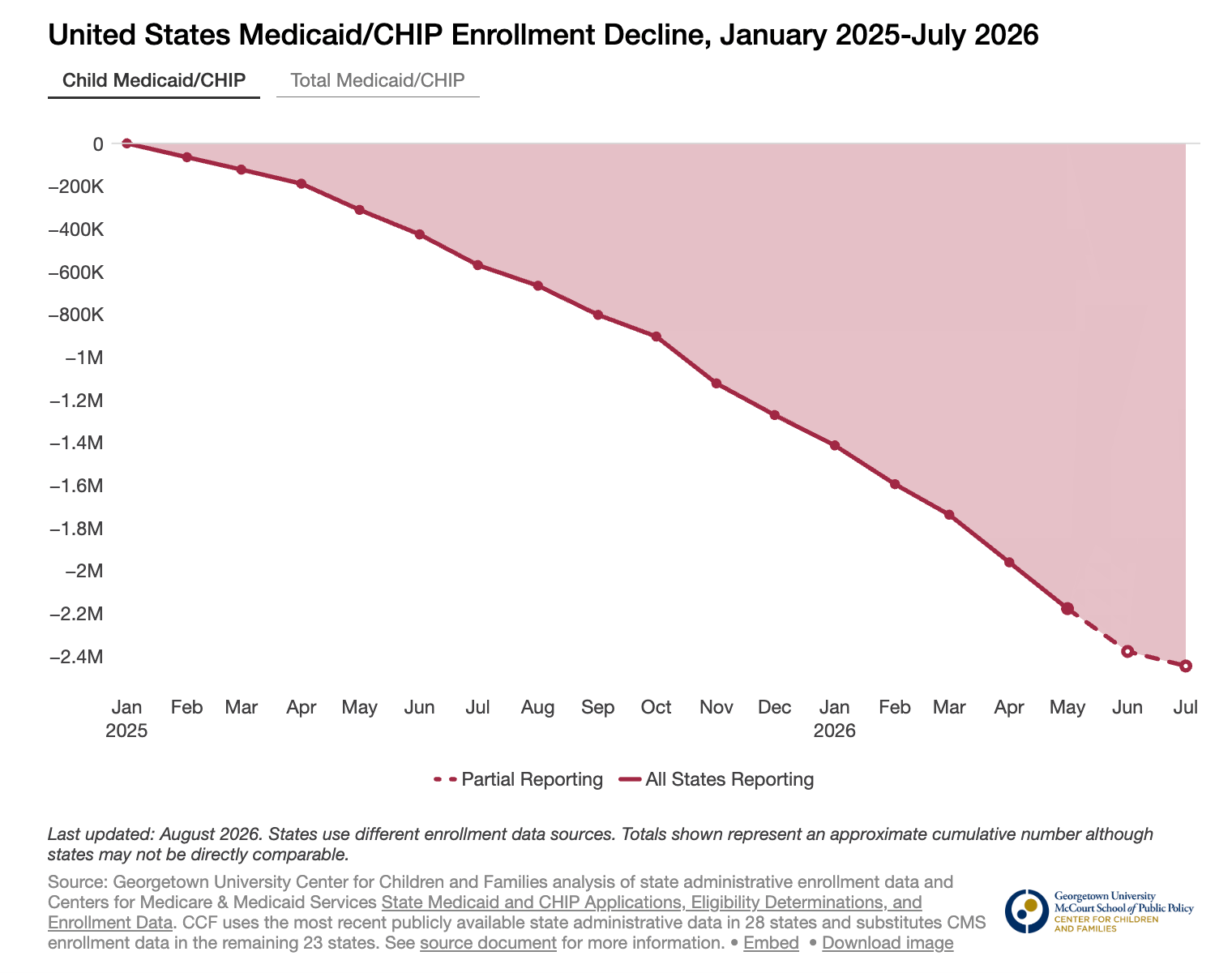
The Congressional Budget Office (CBO) estimates it cut federal Medicaid and CHIP spending by nearly $1 trillion over ten years, which is the largest cut in the programs’ history. CBO projects it will leave about 10 million more people uninsured by 2034. Children, who make up the largest share of Medicaid and CHIP enrollees, are squarely in the path.
Even before these cuts really start taking effect, Georgetown’s Center for Children and Families (CCF) has documented that more than 2 million fewer children have enrolled in Medicaid coverage since the beginning of the current Administration and RFK Jr.’s leadership.
On the matter of immunizations, RFK Jr.’s spreading of distrust and misinformation has helped contribute to the resurgence of measles and other vaccine preventable diseases. In sharp contrast, on February 27, 1962, President John F. Kennedy proposed the Vaccine Assistance Act to promote immunizations:
There is no longer any reason why American children should suffer from polio, diphtheria, whooping cough, or tetanus – diseases which can cause death or serious consequences throughout a lifetime, which can be prevented, but which still prevail in too many cases.
I am asking the American people to join in a nationwide vaccination program to stamp out these four diseases, encouraging all communities to immunize our children and adults, keep them immunized, and plan for the routine immunization of children yet to be born. . . This program would cover the full cost of vaccines for all children under five years of age.
There is no greater flight from the Kennedy family’s health care legacy than what we have witnessed from RFK Jr.

A MAHA Summit Without Much MAHA
“[The FDA] really became a sock puppet for the industry it was supposed to regulate.”
— Robert F. Kennedy Jr., on the FDA, in a speech to agency staff, April 2025
RFK Jr. came to HHS promising to challenge powerful interests that he argued had captured American health care policy. Whatever one’s views of his specific claims or policies (I, for example, strongly disagree with his positions on matters such as vaccines, Medicaid and CHIP cuts, and the proposed gutting of Head Start and children’s medical research), his critique of the relationship between government and concentrated corporate power has been central to his public identity and embraced by supporters of the Making America Healthy Again (MAHA) movement.
However, on September 29, the second annual MAHA Summit convened at the Waldorf Astoria in Washington. Kennedy closed the day in a “fireside chat” with Vice President JD Vance billed around MAHA’s accomplishments and its regulatory agenda. One afternoon panel was titled “Modernizing MAHA regulation.”
Look at who paid for the room. Sponsors reportedly offered packages of up to $300,000. They included Walmart, telehealth firms Hims & Hers and Noom (both sellers of GLP-1 weight-loss drugs), and AI companies OpenAI and Anthropic. Insurance executives, including from UnitedHealth, were on the speaker list. A food panel moderated by a Kennedy counselor featured executives from Walmart, Steak ‘n Shake, and Sweetgreen.
This was supposed to be the movement against corporate capture of health policy. Kennedy’s own 2025 MAHA report accused the food, chemical, and pharmaceutical industries of exactly that. Yet corporations dominated the most recent MAHA conference and deregulation was its focus. For a movement founded, in part, on opposition to regulatory capture, that is a remarkable evolution.
Kennedy’s own base noticed. Dr. Robert Malone, whom Kennedy put on the CDC’s vaccine advisory committee, called the sponsor list “sickening.” Texas physician Mary Talley Bowden said grassroots MAHA had become a “cesspool of corporate interests.”

Again, I strongly disagree with both of them on nearly everything about vaccines. But they are right about one thing: the event had Kennedy’s name on it and somebody else’s agenda inside it.

Inheritance Is Not Legacy
President John F. Kennedy said in a speech in July 1963:
Children are the world’s most valuable resource and its best hope for the future.
What does it mean to inherit a legacy? An inheritance is something you receive, but a legacy is something you leave behind.
Whether Trump is deliberately trolling RFK Jr. or simply doesn’t care, the message is clear that the Kennedy name was useful during the presidential campaign to this Administration as a brand, but not at all as a set of commitments.
Time and time again, when the agenda collides with Project 2025, Office of Management and Budget (OMB) Director Russ Vought’s agenda of dismantling government, the desires of wealthy donors, or the President’s ego, the Kennedy legacy loses every single time.
The Administration’s agenda has included:
Dismantling USAID
Threatening Head Start
Targeting Job Corps for shutdown
Proposing Legal Services for elimination
Eliminating NICHD as an independent and child-focused institute
Threatening Special Olympics (a first term agenda item)
Slashing Medicaid and CHIP
Shutting down the Kennedy Center for the Performing Arts
Paving over the Rose Garden
An extraordinary portion of the architecture and legacy of the Kennedy-Shriver generation has been challenged and attacked in a remarkably short period of time.
Kennedy has a choice. He could defend the programs that his uncles, his father, and his aunt and uncle spent their careers creating. He could object to a summit that sold his movement to the industries he once railed against. He could say, plainly, that his uncle’s memorial should not be held hostage and closed. So far, he has chosen to do none of the above.
The Kennedys of an earlier generation understood that power is measured by what you protect. Robert F. Kennedy walked the Mississippi Delta and saw hungry children with his own eyes.
As RFK said in a March 1968 speech at the University of Kansas:
I have seen children in Mississippi starving, their bodies so crippled from hunger and their minds have been so destroyed for their whole life that they will have no future. . . I have seen children in the Delta area of Mississippi with distended stomachs, whose faces are covered with sores from starvation, and we haven’t developed a policy so we can get enough food so that they can live, so that their children, so that their lives are not destroyed, I don’t think that’s acceptable in the United States of America and I think we need a change.
His son now runs the department responsible for those children. By the standard his father articulated, the comparison is not even close.
A War on Children, with RFK Jr. at the Helm
President Kennedy said in a February 14, 1964, message to Congress:
To the extent that the Nation is called upon to promote and protect the interests of our younger citizens, it is an investment certain to bring a high return, not only in basic values but in social and economic terms.
When I was a child, I thought the Kennedy legacy was all about John F. Kennedy and his inspiration. I understand it much differently now.
It is a Head Start teacher welcoming a 4-year-old into a classroom, a Special Olympics athlete crossing a finish line, a scientist at NICHD working to address developmental disabilities, a child getting cancer treatment or an immunization with their Medicaid or CHIP insurance card, a young person getting another chance through Job Corps, or a Peace Corps volunteer leaving home to serve people half a world away.
Those are monuments too, but unlike marble or stone, they survive only if each generation decides they are worth keeping.
To me, the veneer of Camelot isn’t what is inspiring about the Kennedy family. It is the idea that government can ask something of us and do something for us and the next generation. It is the belief that public service matters. And it is the conviction that poverty, disability, illness, and the circumstances of a child’s birth should not dictate the boundaries of that child’s life.
Again, as President Kennedy said:
All Americans recognize that our children and youth are the most important asset and resource. . . If, for the sake of our nation as well as their own families, our children and young people are to grow into productive adult members of society and bear the responsibility of the legacy we leave them – that of the world’s most powerful and economically advanced nation – then all of them must have the fullest opportunity for moral, intellectual, and physical development to prepare adequately for this challenge.
In sharp contrast, ProPublica’s Eli Hager catalogued this Administration’s policies toward children under a blunt headline: “The Trump Administration’s War on Children.”

The piece documented cuts to child abuse investigations, child support enforcement, child care, and children’s health, all at once. It was not a list of coincidences, but a direction and roadmap.
I have spent the last two years chronicling that direction on this page, piece by piece: the slashing of children’s health coverage and immunizations, the attacks on birthright citizenship, the dismantling of the Department of Education and the attempt to shove special education back into a health bureaucracy, the erosion of the Child Tax Credit. USAID, Head Start, Medicaid, and CHIP are not just separate threats to children but part of an overall strategy of “organized abandonment” of the next generation.
At First Focus on Children, we hold every policymaker to one question: “Is it good for the children?” That is also a pretty good test of a legacy.
Robert F. Kennedy said in a 1968 interview with David Frost:
. . .perhaps this world is a world in which children suffer, but we can lessen the number of suffering children, and if you do not do this, then who will do this? I’d like to feel that I’d done something to lessen that suffering.
That is a Kennedy legacy worth protecting and aspiring toward. However, this Administration has demonstrated a commitment to tearing much of it down.
For the sake of our children, this must change.