


First Focus on Children has released Children’s Budget 2026, our annual accounting of what the federal government actually spends on kids across more than 250 programs.
The numbers are damning. The children’s share of federal spending has fallen more than 30% since FY 2022, from 12.16% to just 8.43% in FY 2026. The decline is accelerating: the Trump Administration’s proposed FY 2027 budget would allocate just 7.90% to children.
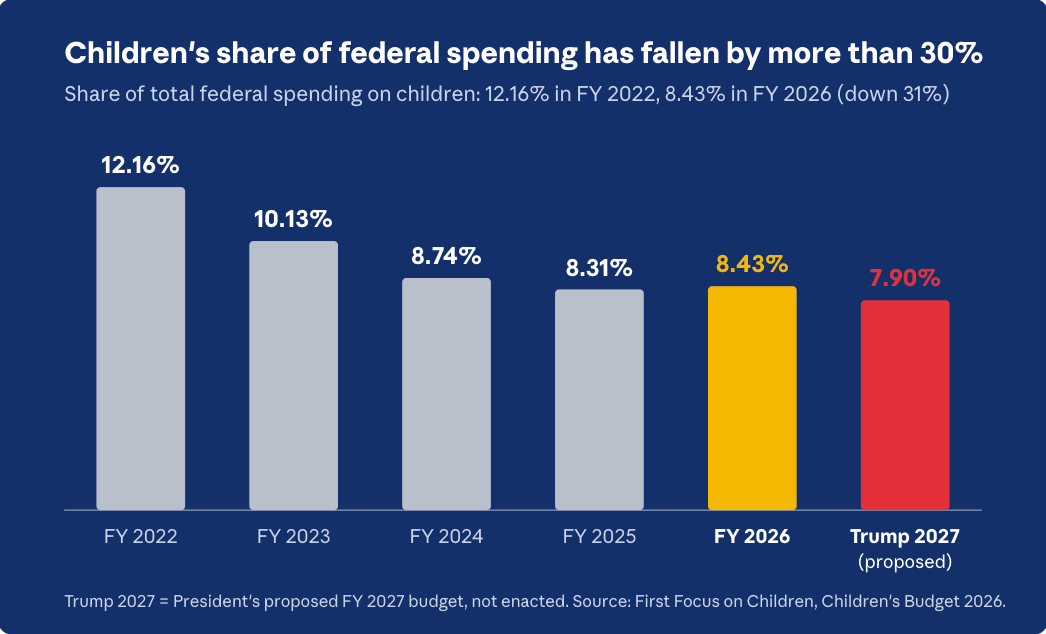
Funding for children is being squeezed out and shortchanged by other rapidly growing sections of the budget. Under President Trump’s FY 2027 budget proposal, total federal spending would grow by more than $400 billion over FY 2026. In sharp contrast, spending on children would decline by $5.7 billion. While the federal budget would grow by hundreds of billions of dollars, children (who already start with a small percentage of funding) would be slashed.
On the discretionary side of the budget, defense spending claims 52% compared to just 7.26% for all children’s programs combined. Moreover, interest on the debt, which is a burden that our children will bear in the future, is one of the fastest growing line items in the federal budget and crowds out investments children need today.
Meanwhile, spending on children internationally — fighting childhood HIV, tuberculosis, and malaria, and protecting children from trafficking — fell from 0.09 cents to 0.06 cents of every dollar in federal spending. The Trump Administration’s FY 2027 proposal would cut it to 0.03 cents – a cut of two-thirds from FY 2025 levels.
What follows largely follows my message opening this year’s report.
On the Wrong Path: Why the Federal Budget Keeps Failing Our Children
A few years ago, in these pages, I wrote that America’s children stood at a crossroads. That was generous. A crossroads implies a choice not yet made. Children’s Budget 2026 makes clear that the choice has been made, repeatedly, year after year — and it is the wrong path.
In fiscal year (FY) 2026, the federal government invested just 8.43 cents in children out of every dollar it spent. That is a drop of more than 30% from the FY 2022 peak of more than 12 cents, or 12%, when pandemic-era investments briefly gave children something a bit closer to their fair share.
Since then, lawmakers have let that support lapse, and the retreat has continued nearly every year since. If the Trump Administration’s FY 2027 budget proposal were enacted, the share would fall further still, to just 7.90%: the lowest level since the first Trump Administration, and a level not seen in years before that.
Children make up more than one-fifth of the U.S. population. Yet just about 1-in-12 dollars of federal spending is devoted to them. That gap is not an accident of arithmetic. It is a design.
A Budget Process Built to Forget Kids
Every year, I explain the same data points, and every year I’m asked the same question: why does this keep happening? The honest answer is that the federal budget process itself is stacked against children, in ways that have nothing to do with how much lawmakers say they care.
In contrast, most spending that benefits older Americans — Social Security and Medicare — is mandatory, grows automatically with need, is protected by law, and is insulated from the annual scramble of appropriations. Spending on children runs almost entirely the opposite way.
Spending on children is disproportionately discretionary, meaning it must be re-justified, re-appropriated, and re-fought every single year. It is capped where adult programs are not. It expires where adult programs renew.
As the Committee for a Responsible Federal Budget (CRFB) has documented for nearly a decade now, this isn’t a partisan tilt — it’s structural, and it produces the same result year after year: children’s programs erode while programs that don’t require annual permission slips keep growing.
You can see the mechanism in this year’s numbers. Mandatory spending on children — Medicaid chief among it — rose slightly in FY 2026, not because Congress chose to prioritize kids, but because demographic and economic need pushed enrollment up automatically.
Discretionary spending on children, the part that actually reflects a proactive choice by lawmakers, fell again. In FY 2026, children received just 7.26% of all discretionary spending, while defense claimed 52%.
The problem was never a lack of money. It was, and remains, a lack of will and a budget architecture that makes that lack of will almost automatic without anyone ever having to cast a vote against kids by name.
The Evidence Was Never the Problem
If the case for investing in children needed more proof, we have it. The strongest of it comes from economists who spent decades focused on what we would argue was the wrong question.
Instead of focusing on children themselves, for much of the last half-century, economic research focused on adults and on the narrow question of “does helping poor families discourage work?” It rarely asked what that help did for the children inside those families. That has changed.
As researchers Anna Aizer, Hilary Hoynes, and Adriana Lleras-Muney have found, by using better data and longer time horizons, research is increasingly finding that investments in children have a high rate of return and should reorder how Congress thinks about every dollar it puts into, or takes out of, children’s programs.1
As they write:
A new focus on the benefits of safety net programs on children — the intended beneficiaries of these programs — that incorporates evidence on their many long-term benefits can contribute to the design of better policies going forward.
For example, take Medicaid. Children who had access to coverage went on to enroll in college at higher rates, delay having children, and live longer as adults. They also paid enough in additional taxes over their lifetimes that the government recouped 58 cents of every dollar spent on their childhood eligibility, without even counting the other benefits. A separate study of the program’s earliest years reached an even starker conclusion: childhood Medicaid coverage saved more than twice its own cost.2
Take food assistance. Children with early access to food stamps went on to complete more education, earn more, live in better neighborhoods, and experience less poverty, less illness, and less incarceration as adults. Economists measure a program’s return using something called the “marginal value of public funds” — essentially, what a dollar of public spending is worth relative to what it costs. Counting only the program’s effects on the adults who received it, that figure is 54 cents on the dollar: a loss. Counting what it did for the children in those households, it rises to 56 dollars of value for every dollar spent.3
Take the Mothers’ Pension programs, an early form of public cash assistance that begin in 1911. Judged only by its short-term cost and its effect on the mothers who received it, the return looks weak — 84 cents on the dollar. Judged by what happened decades later to the children who grew up in those households — more schooling, more years of life, higher earnings — the return climbs above $5 for every dollar spent.4
The pattern holds across nearly every safety net program economists have studied closely enough to trace into adulthood: investments in children pay for themselves, in a way that investments aimed at adults typically do not.5
That is not a coincidence of the programs chosen for study. It is what happens when you measure the right thing over the right amount of time. Unfortunately, it is precisely what a 10-year congressional budget window is built not to see.
None of this required 2021 to prove that investments in children matter. But 2021 offered the clearest live demonstration: the temporary expansions of the Child Tax Credit, nutrition assistance, and child care support that year cut the child supplemental poverty measure (SPM) nearly in half, to a historic low of 5.1%. Then Congress let it all expire, and child poverty more than doubled to 13.4% in 2025.
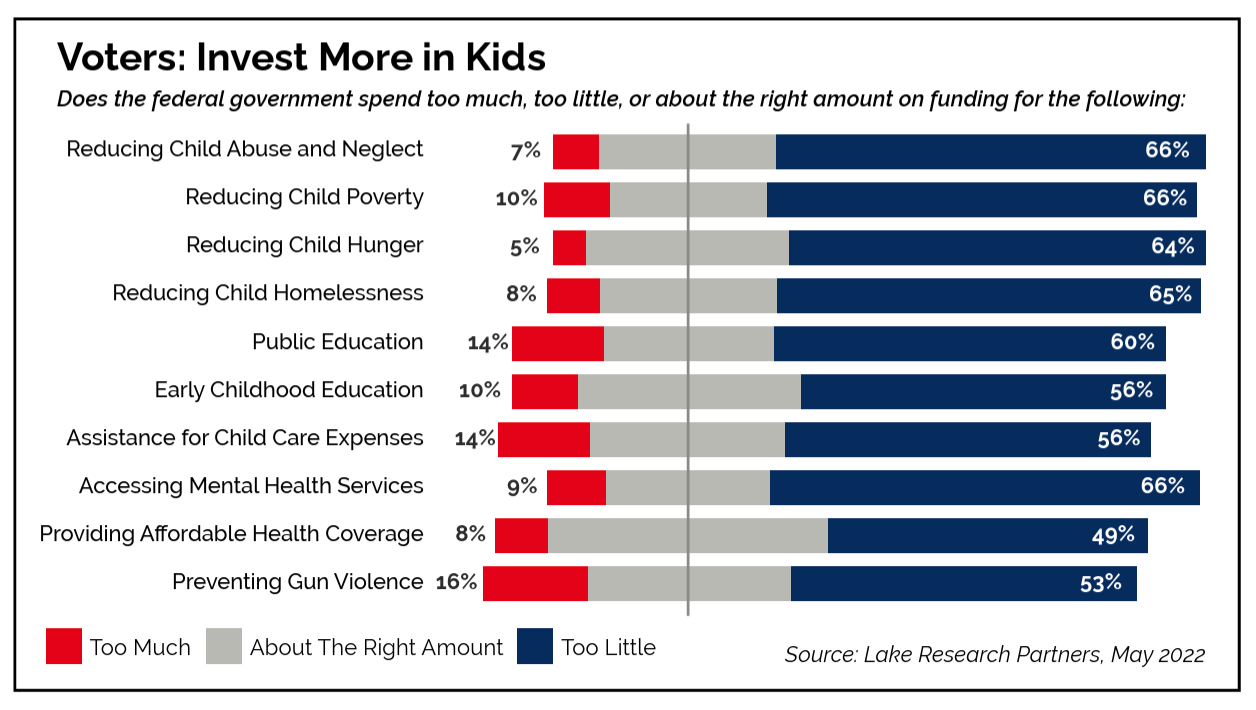
Americans understand what happened, even if Washington has chosen to ignore it. In polling conducted by Lake Research Partners, voters have consistently expressed — by margins as lopsided as 12-to-1 — that they want more federal investment in children’s health, safety, and economic security, not less.6
The American people get it.
The Retreat Doesn’t Stop at Our Borders
The same wrong path shows up, even more starkly, in what the United States spends on children beyond its borders. In FY 2026, the share of federal spending devoted to children internationally fell by one-third, from an already meager 0.09% to just 0.06% of total federal spending. The Trump Administration’s FY 2027 budget would cut that in half again, to 0.03% — or 3 cents for every $100 the federal government spends.
These are not abstract numbers. The dismantling of the U.S. Agency for International Development (USAID) eliminated much of the infrastructure that delivered life-saving nutrition, malaria and tuberculosis treatment, and maternal and child health care to some of the world’s most vulnerable children. Public health researchers estimate 200,000-to-300,000 children have already died as a result,7 and a Lancet-published analysis projects that toll could reach 4.5 million children under 5 by 2030 if these cuts are not reversed.8
The justification offered for these cuts — that foreign aid was a meaningful driver of federal deficits — never held up. Foreign assistance made up roughly 1% of the federal budget before these cuts began. Eliminating it saved almost nothing and cost almost everything for the children who depended on it most.
A budget process stacked against children at home is stacked doubly against children who have no domestic constituency to speak for them at all.
What This Report Is For
Children’s Budget 2026 exists because someone has to keep counting. For more than 250 federal programs, across nearly every agency, we track what the government actually spends on kids — not what it says, not what it intends, but what shows up in the ledger.
Prior to our starting this project in 2008, presidents used to release their budget and declare they were doing right by children by pointing to a line-item or two for kids that were being increased even if other areas were being cut. Children’s Budget and its companion piece, Babies in the Budget, have told the real story – both good and bad – for nearly two decades now.
This year’s ledger tells a clear story: the country is no longer at a crossroads. Federal policymakers have chosen a path and have been walking down it for five straight years, and it is one that is rapidly disinvesting in our children, our future. Our publications tell that story and give the Children’s Budget Coalition and others the data to hold lawmakers accountable for doing better by our children.
Our Ongoing Budget Work Is Being Threatened
Unfortunately, our continued work (an entire staff effort) on the budget is endangered. Funding for the Children’s Budget, our leadership of the Children’s Budget Coalition, and our related analysis of Babies in the Budget has declined sharply in the last two years. Without replacement support, our analysis of federal spending on children internationally will likely end after our funding for that work expires at the end of the year.
If you value an independent voice and analysis of how budget decisions affect children across the federal government, please consider supporting First Focus on Children. Your donation and support help us keep producing the evidence advocates need to hold policymakers accountable.
Choose a Different Path
In the U.S., children are not allowed to vote and do not have dedicated Political Action Committees (PACs), membership groups, or lobbyists demanding attention to their best interests and well-being. They rely on adults and child advocates like us to insist that their needs and best interests count.
To do so, we need to choose a better path. But that choice will not make itself. It will take the same thing it always has: people who refuse to let children be cast aside as an afterthought in our political system and budget process.
Congress and the President must reverse this trend now. Every one of these numbers that I have cited is a choice, and every one of them can be chosen differently in the next appropriations bill, the next budget, the next reconciliation package.
If we care about our kids and their future, we must demand that our politicians and policymakers do better.
Kids can’t wait.
Endnotes
Aizer, A., Hoynes, H., & Lleras-Muney, A. (2022). Children and the U.S. Social Safety Net: Balancing Disincentives for Adults and Benefits for Children. Journal of Economic Perspectives, 36(2), 149–174.
Brown, D. W., Kowalski, A. E., & Lurie, I. Z. (2020). Long-Term Impacts of Childhood Medicaid Expansions on Outcomes in Adulthood. Review of Economic Studies, 87(2), 792–821; Goodman-Bacon, A. (2021). The Long-Run Effects of Childhood Insurance Coverage: Medicaid Implementation, Adult Health, and Labor Market Outcomes. American Economic Review, 111(8), 2550–2593. Both cited in Aizer et al. (2022).
Bailey, M. J., Hoynes, H. W., Rossin-Slater, M., & Walker, R. (2020). Is the Social Safety Net a Long-Term Investment? Large-Scale Evidence from the Food Stamps Program. NBER Working Paper 26942. Cited in Aizer et al. (2022).
Aizer, A., Eli, S., & Lleras-Muney, A. (2020). The Incentive Effects of Cash Transfers to the Poor. NBER Working Paper 27523. Cited in Aizer et al. (2022).
Hendren, N., & Sprung-Keyser, B. (2020). A Unified Welfare Analysis of Government Policies. Quarterly Journal of Economics, 135(3), 1209–1318. Cited in Aizer et al. (2022).
Lake Research Partners (2022, Apr.). National survey on family economic security and the Child Tax Credit. Cited in Lesley, B. (2025, November 27). Money Matters: The Nation’s Retreat from Kids. Kids Can’t Wait.
Mathew, Angela (2025, Jul. 1). USAID cuts have caused more than 330,000 deaths worldwide, BU professor estimates, Boston Globe; citing Brooke Nichols’ Impact Counter tracker, Boston University School of Public Health.
Cavalcanti, D. M., et al. (2025). Evaluating the impact of two decades of USAID interventions and projecting the effects of defunding on mortality up to 2030: a retrospective impact evaluation and forecasting analysis. The Lancet, 406(10500), 283–294. https://doi.org/10.1016/S0140-6736(25)01186-9.
Interest on the debt is the other half of this squeeze. CBO’s preliminary tally put net interest above $1.1 trillion for fiscal 2026, so it’s competing with every other line, children’s programs included. Does your budget count debt interest as a separate pressure?