


Two proposals to remake federal child welfare financing are now circulating in Washington. The Bipartisan Policy Center (BPC) released Charting the Course a few months ago. And on September 30, United Family Advocates (UFA) released Supporting Strong Families and Safe Children, a framework to restructure about $11 billion a year in federal child welfare funding.
The people behind them include former state child welfare directors, family defense attorneys, parent advocates, and conservative policy experts. Many of them have spent their careers trying to keep children safe and families together. I share their goal: fewer children separated from their families when they could safely stay home.
But both reach for the wrong tools and, I believe, capitulate too easily.
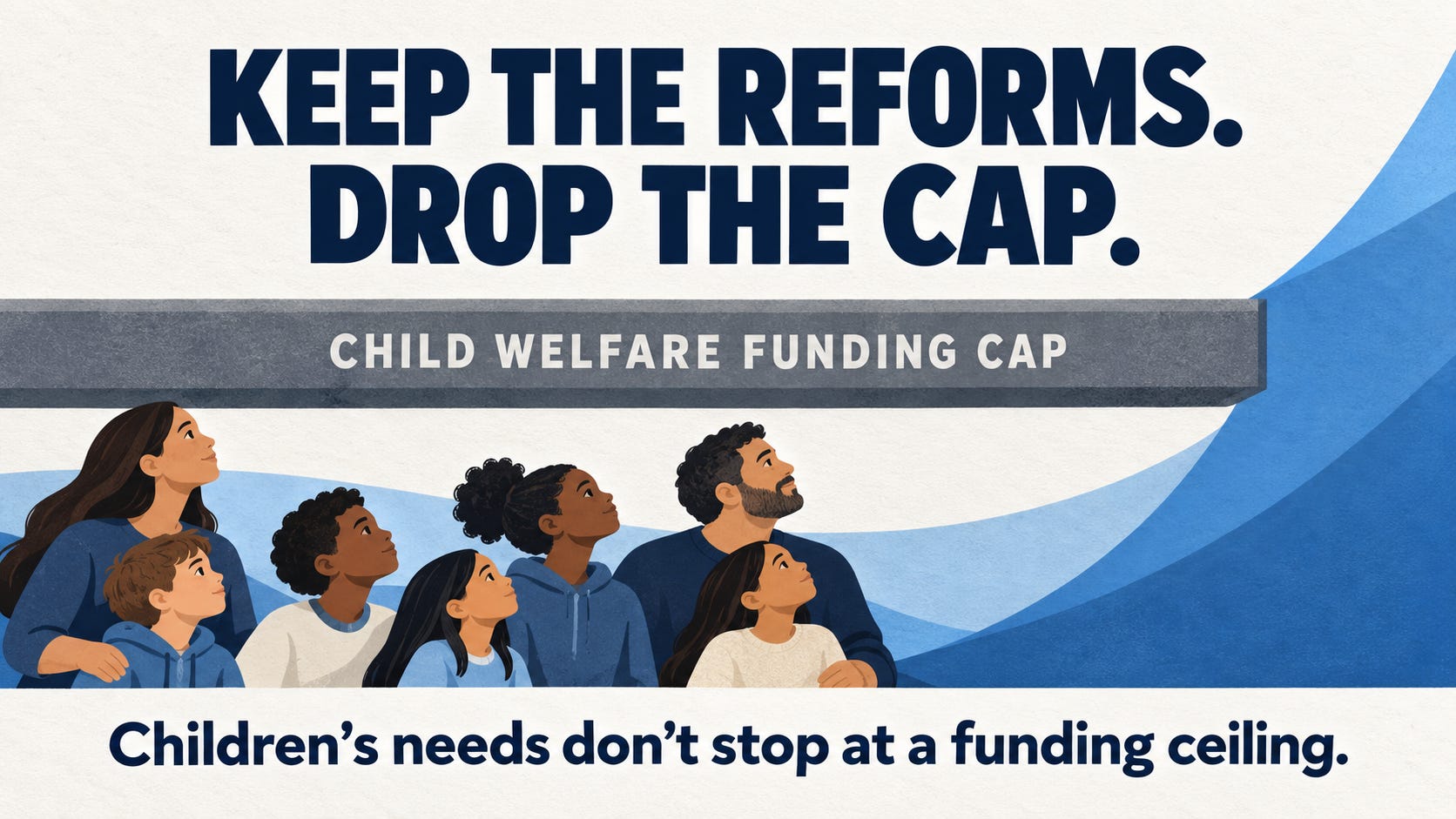
For example, each would arbitrarily cap Title IV-E funding, the federal government’s largest child welfare funding stream and the one that, for more than four decades, has grown when children and families needed it to.
UFA would cap nearly all of it. That is a mistake that has been made or attempted many times before, and children paid for it.
Although BPC keeps adoption, guardianship, and prevention as entitlements, it caps foster care and administration in a single formula grant. BPC would adjust the grant for the cost of living, but that is not enforceable and a formula set in advance is still a cap: it may or may not grows by arithmetic, but definitely not with need. Once the principle is conceded, the rest is a matter of time and the next budget deal. BPC also suggests some changes to Medicaid that I believe should be rejected outright (but more on that in a forthcoming blog).
Some Truths That Should Govern This Debate
Before arguing about federal funding formulas, we should agree on what is true and be sure to keep children centered in this debate.
Child welfare is often argued in black and white terms. One side says the system tears apart too many families and should be dismantled. The other says it leaves too many children in danger and should act sooner. Each is describing something real, and each, taken alone, would hurt children.
The right answers in this field are almost always somewhere in between or in the “grey zone.” Solutions require balance, judgment, and the humility to hold several truths at once. Any proposal that promises a simple fix, whether abolition, more removals, or a single financing formula, should be met with skepticism.
These truths are uncomfortable for nearly everyone. Good policy should honor them.
Some parents do monstrous things to their children. In 2024, 1,773 children died from abuse or neglect in this country, most of them babies and toddlers. Protecting children from the people who would harm them is a core parens patriae duty of government, not an optional one.
Families are best for children, and the system too often fails the children it removes. Too many children are taken from homes that could have been made safe, then moved from placement to placement, school to school, until some age out with no family to call their own.
Poverty is not neglect. A family that cannot pay the rent, keep the heat on, or find child care needs support and assistance, not an investigation.
Children are not property, of their parents or of the state. They are people with fundamental rights of their own.
Yet children in our society lack fundamental rights, protections, and voice, including in the child welfare system. Too many children go through child welfare and court proceedings that will decide their lives without their voice and concerns being considered.
Parental rights deserve respect and protection, but never in a way that enables, facilitates, or shields child abusers. Laws are being proposed at the federal and state levels that codify parental rights in a manner that can threaten children’s health, education, safety, and well-being.
Outcomes for abused children are deeply troubling, both for those left in abusive homes and for those in the care of the state.
We should invest far more in prevention, meaning the prevention of abuse and neglect themselves, not just the prevention of foster care placements.
Child welfare should not be a silo. Child and family well-being is the shared responsibility of many systems: health care, mental health and substance abuse treatment, housing, hunger, and income supports. Child welfare cannot do it alone, and should not be left to try. Reducing child poverty, homelessness, and hunger lowers family stress, and with it both abuse and the neglect cases that pull families into the system.
This is not a zero-sum game. In a 2022 poll by Lake Research Partners, the American people believe we spend too little, not too much, to address child abuse (66-7%), child poverty (66-10%), homelessness (65-8%), hunger (64-5%), and mental health care (66-9%). By overwhelming margins, the public supports greater investments. Reformers who accept a fixed pot have conceded something the public never asked them to.
The system should be judged by how children fare, not by counts of removals, caseloads, or dollars moved between funding streams.
The people who live it belong at the table. Young people and parents who have been through the system know what works and what harms, and policy written without them shows it.
Where They Are Right
Let me start with what these proposals get right.
Too many children are removed from their homes. Most removals are for neglect rather than abuse, and neglect is too often a stand-in for poverty: no stable housing, no child care, a utility shutoff, or an untreated illness. Neglect often involves real problems, like parental substance use or untreated mental illness. But it is also deeply entangled with poverty: families without stable housing, child care, or affordable treatment are far more likely to be reported, investigated, and separated. That burden falls hardest on Black and Native families. Black children are about 14% of the nation’s children but 22% of children entering foster care. Native children are 1% of children and 3% of entries.
The UFA framework also contains reforms that should be supported:
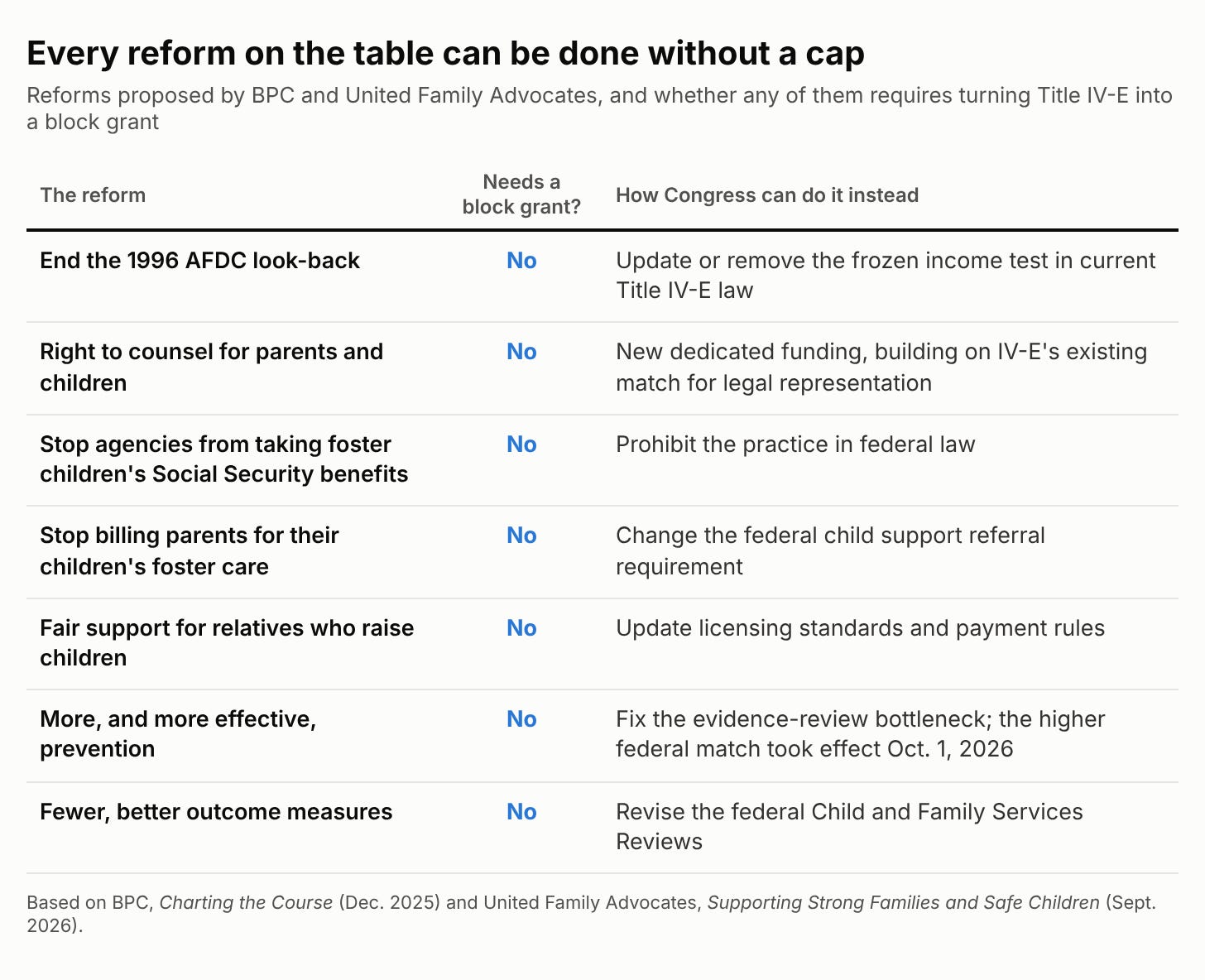
A real right to counsel for parents and children, including before a case is filed, funded outside the child welfare agency
An end to billing parents for their children’s foster care
An end to agencies taking foster children’s Social Security benefits to pay for their own care
Equal support for relatives who take in children, whether through licensing or TANF
Cutting the tie between foster care eligibility and 1996 welfare rules
The diagnosis is largely right. Most of the remedies are right.
The major problem with the proposal is its financing mechanism, and none of these reforms requires it.
Protecting Children from Harm Is Not Optional
There is another truth that belongs in this debate, and it is too often left out. Child abuse is real and far too common. It creates lifelong and intergenerational harm, and even leads to death.
In 2024, state child protective services confirmed 532,228 children as victims of abuse or neglect. That year, 1,773 children died from maltreatment, most of them babies and toddlers. Researchers and federal auditors have long warned that fatalities are undercounted. Behind every one of those numbers is a child who needed an adult to step in, and too often no one did in time.
A September 2026 audit by the Department of Health and Human Services (HHS) Inspector General found that Arkansas’s child abuse hotline screened out a report from an 11-year-old who said a family member had raped her, because staff thought a young child might not understand the word “rape.” Auditors estimated that an astounding 99% of the reports Arkansas did accept failed at least one requirement for screening, safety assessment, or investigation, and the state cited heavy workloads and staffing shortages. A financing system that rewards states for reducing caseloads, with no room to grow when need does, makes failures like these more likely, not less.
The disparities run in this direction too. Black and Native children are the most likely to be investigated and removed. Black children are also the most likely to die from maltreatment: 548 Black children died in 2024, more than children of any other race, at a rate of about 6 per 100,000. The same families harmed by over-surveillance are also failed when real danger is missed. Both things are true, and a just system has to answer for both.
The harm does not end when the abuse does. Physical abuse, sexual abuse, and severe neglect change how a child’s brain and body develop. They show up years later in school, in mental and physical health, and in the next generation. Children who cannot safely stay home need a real place to go: a relative who is supported, a foster family that is trained and paid fairly, a therapist who takes Medicaid, and a caseworker with a caseload small enough to actually see them.
Conservatives who warn about children left in dangerous homes are right to do so. Family advocates who warn about children torn from loving but poor homes are right too. The answer is neither “abolish” nor “remove when in doubt.” It is a system funded well enough to tell the difference, and to act on it: support for the family that is struggling, protection for the child who is in danger.
In the closing section of the report by the Commission to Eliminate Child Abuse and Neglect Fatalities, Commissioner Jennifer Rodriguez wrote:
We need to invest in rigorous research to develop a knowledge base about the services, supports, and interventions that support families in healing and health. We must offer vulnerable families who are devastated by the impacts of mental illness, substance abuse and poverty concrete resources such as immediate access to mental health and substance abuse treatment that allows parents and children to remain unified, subsidized high quality childcare, and in home supports in lieu of removal whenever possible. And we must engage and listen to the voices of families and youth about what is working, what is needed, and what is not helpful.
That is also why the child welfare financing structure matters. Need in child protection is not predictable. The opioid epidemic drove foster care numbers up for five straight years in the last decade. As the number of children in care rose, so did federal Title IV-E foster care funding. A capped grant would not have grown with the rise in need. No formula written in 2026 can know what the next crisis will bring. When need rises, an entitlement grows to meet it. When need outruns the arbitrary cap, states are forced to choose which children to protect. A child’s safety should not depend on whether a block grant formula guessed right.
What the BPC and UFA Proposals Actually Do
Today, Title IV-E is an open-ended entitlement. When a state spends on foster care, adoption assistance, guardianship, or, since the Family First Act of 2018, prevention services for eligible families, Washington pays a share. No one has to win an appropriations fight for that money to grow when need grows.
Yet, the UFA framework would replace that guarantee with three capped grants:
Child Protection: $9.5 billion, consolidating IV-E foster care, adoption assistance, and guardianship assistance
Family Legal Representation and Court Improvement: $545 million
Family and Community Support: about $1 billion, consolidating Title IV-B, IV-E prevention, and adoption incentives
Adoption subsidies are long-term commitments to families, often raising children with disabilities. Under UFA they would be paid out of a fixed pot. So would prevention, frozen at $203 million, which is simply what states drew before the program had fully ramped up. UFA concedes this in a footnote: folding IV-E prevention into the new grant “would mean capping it.” Its answer is a recommendation that allocations “account for increased use.” That is a hope, not a mechanism.
Although BPC keeps adoption, guardianship, and prevention as entitlements, it caps foster care and administration in a single formula grant. Once the principle is conceded, the rest is a matter of time and the next budget deal. There is a long, sad history of how capped programs fare for children.
UFA argues that “a central policy question is not whether funding is in an entitlement structure or not, but whether it is stable, transparent, and designed and actually used by states to support better outcomes.” But stability is precisely what the entitlement provides and the adoption of an arbitrary cap takes away. For the children who will need help in the next economic recession, the next drug epidemic, or natural disaster, the structure is the question.
Furthermore, at First Focus on Children, we just released Children’s Budget 2026, which shows that federal spending for kids dropped to just 8.43% in 2026. The Committee for a Responsible Federal Budget (CRFB) has identified the following structural mechanisms that have shortchanged children in comparison to adults and senior citizens. They include:
While much of spending on adults is mandatory, spending on children is disproportionately discretionary and thus must be reviewed and renewed through the appropriations process every year.
Spending on children is disproportionately temporary and requires far more regular reauthorization than programs for adults, making it perpetually vulnerable to shifting political winds.
Spending on adults is rarely limited while spending on children is often capped, constraining what can be spent for most major children’s programs even when need is high.
Most programs for children lack built-in growth, which causes spending on children to erode relative to spending on adults and relative to the economy over time.
Both BPC and UFA would embrace these very structural mechanisms that have historically shortchanged children.
Another Premise Is Wrong
The case for a cap in foster care funding also rests on a claim: that open-ended federal money pulls states toward removing children. As UFA board member Andrew Brown of the Texas Public Policy Foundation put it to The Imprint, federal funding “rewards family separation.”
The Administration’s own numbers say otherwise. In August, the Department of Health and Human Services (HHS) published a brief on how much of foster care Washington actually pays for. Because eligibility is still tied to 1996 welfare rules, only 33% of children in foster care received a IV-E maintenance payment in FY2024, down from 40% just five years earlier. Counting every child states serve, the federal government covers about 21% of foster care maintenance costs.
In other words, for every dollar a state spends to feed, clothe, and house a child in foster care, the federal government pays about 21 cents. That is a weak pull. It begs the question: “Does it pull at all?”
After comparing each state’s effective federal share, from HHS’s own tables, with how often that state removes children, there is no relationship.
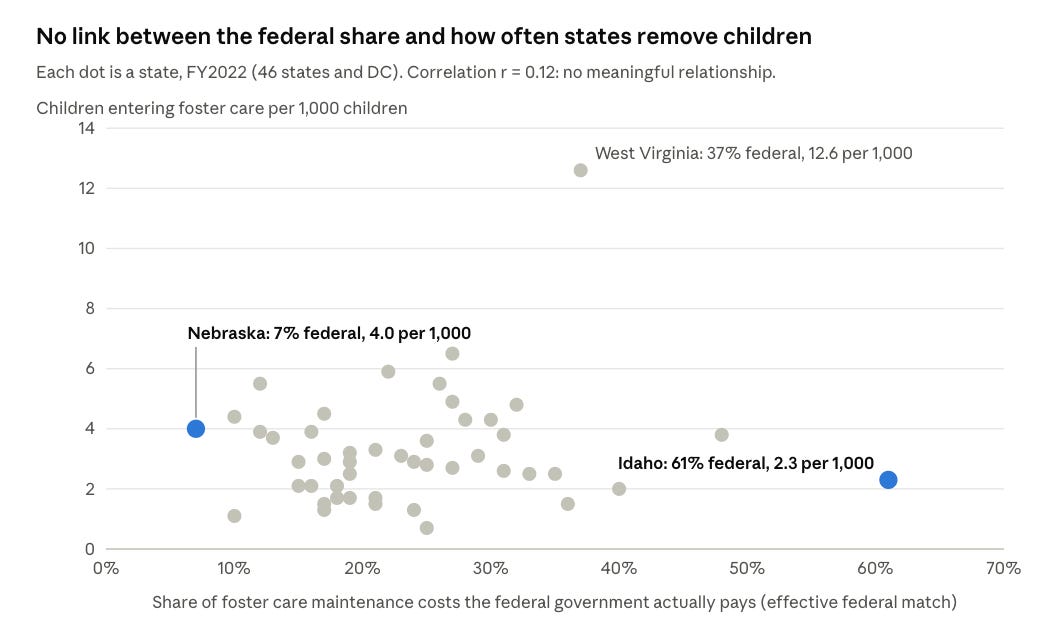
For example, according to HHS, the federal government pays about 7% of Nebraska’s foster care maintenance costs, yet Nebraska removes children at 4.0 per 1,000. In contrast, it pays about 61% of Idaho’s, and Idaho removes children at 2.3 per 1,000. Across all states, those where Washington pays the least have a median removal rate of 3.8 per 1,000; those where it pays the most, 2.6.
This comparison cannot rule out every incentive at the level of an individual case, and removal rates are driven mostly by other forces: poverty, the opioid crisis (look at West Virginia), state law and practice. But those making the causal claim carry the burden of proof, and the federal government’s own data do not support it.
We Have Seen This Before
The proposals’ defenders say this time is different, because their grants come with protections: a hold-harmless so no state gets less than it does today, adjustments for inflation or population, and a state maintenance-of-effort requirement.
We have witnessed this rodeo before. TANF had those “protections” too. In 1996, each state’s TANF grant was built on its own past welfare spending, a hold-harmless in all but name. States had to keep spending 75-to-80% of what they had spent before, a maintenance-of-effort requirement. And the block grant was sold as a way to give states flexibility to do better by poor families.
Here is what happened:
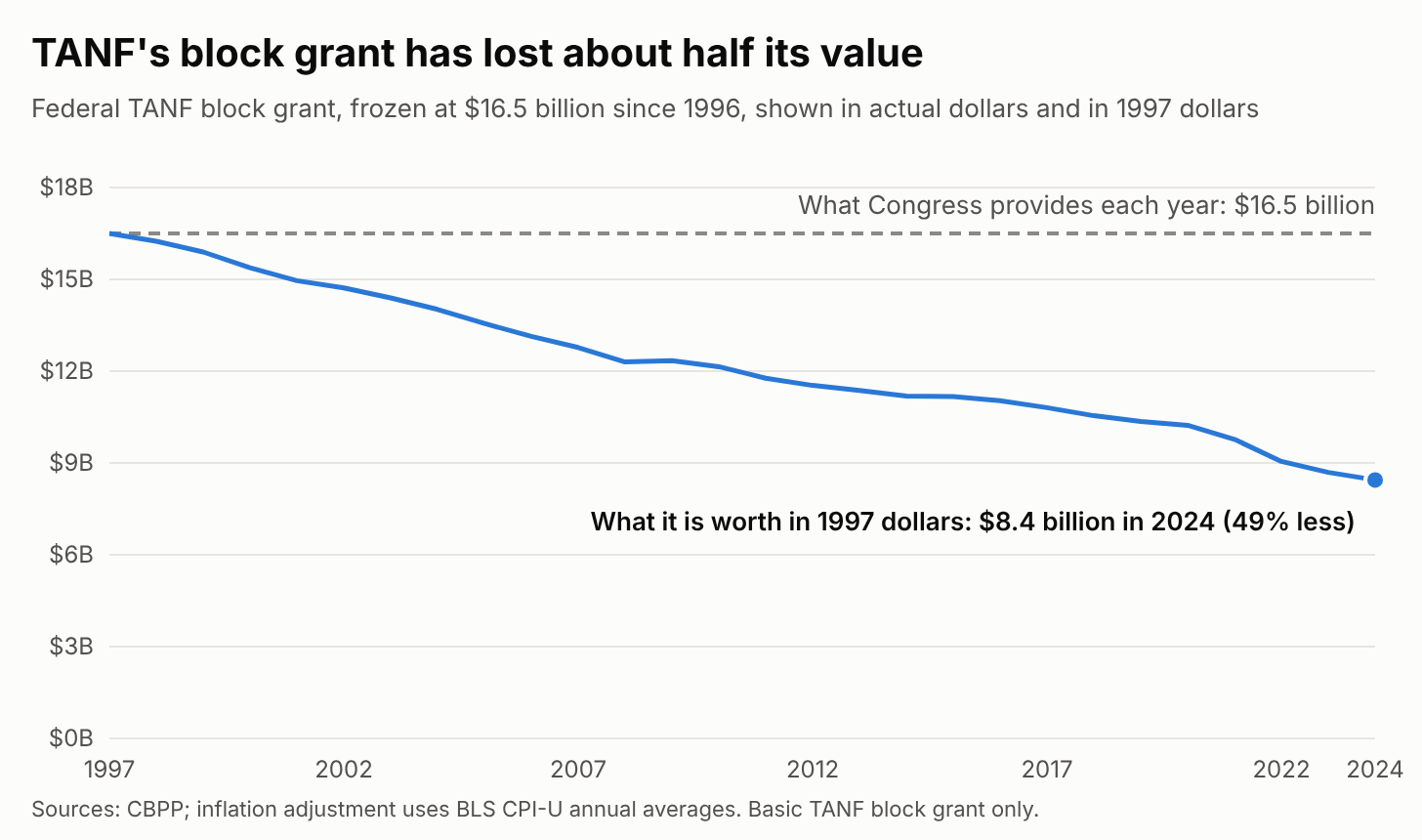
The federal grant has been frozen at $16.5 billion a year since 1996. Inflation has eaten roughly half its value.
In 1996, TANF reached 68 of every 100 families with children in poverty, according to the Center on Budget and Policy Priorities (CBPP). Today it reaches about 21.
Cash help to families fell to less than a quarter of TANF spending.
In the Great Recession, unemployment doubled but TANF caseloads rose only about 15%. Congress had to pass emergency money because the block grant could not respond.
Because each state’s grant was frozen at its 1990s welfare spending, the inequities of that era were locked in. Some states still receive several times more per poor child than others.
Fast-growing states got extra “supplemental grants” to keep up with population growth. Congress let them expire in 2011.
The TANF block grant not only locked in place vast historical funding disparities and has exacerbated them for children living in poverty.
The Social Services Block Grant tells the same story. It stood at $2.8 billion in the early 1990s. It is $1.7 billion today, before sequestration trims it further.
That last point matters. As Sean Hughes of Social Change Partners told The Imprint, capped programs are hit again and again by sequestration and funding freezes, while IV-E “has always been spared.” The entitlement is not just a funding formula. It is a shield.
And the protections being offered now are weaker than they look. UFA’s grants would be indexed to inflation and child population. Neither is guaranteed and neither tracks a surge in need. And as Wendy Henderson of Evident Change noted, a baseline set from today’s historically low foster care numbers means “a lot of states would end up frozen at a really low level of funding.”
During Senate floor consideration in 1995 of a proposal to convert Medicaid from an entitlement into a block grant and make it unresponsive to changes needs, Sen. Bob Graham (D-FL) told proponents of such a change:
I have a warning. . .or more accurately a proverb for them. The proverb goes as follows: Fish see the worm, not the hook.
The Real Fix
Here is the irony at the center of this debate. Title IV-E is already being capped, quietly, by the 1996 look-back.
A child qualifies for federal foster care support only if the family they were removed from would have been eligible for welfare under the rules each state had on July 16, 1996. Those income limits have never been adjusted for inflation. In Indiana, the limit for a family of three is $320 a month. Every year, fewer families fall below it, and the federal share shrinks. That is the same mechanism that hollowed out TANF: a fixed number left to erode. That is not a model to copy. It is a warning.
Congress knows how to fix this kind of problem. A bipartisan bill, the SSI Savings Penalty Elimination Act, led by Sens. Catherine Cortez Masto (D-NV), Bill Cassidy (R-LA), Ron Wyden (D-OR), and Susan Collins (R-ME) and Reps. Danny Davis (D-IL) and Brian Fitzpatrick (R-PA), would update SSI’s asset limits, frozen since 1989, and index them to inflation going forward.
As Michele Stockwell, President of Bipartisan Policy Center (BPC) Action, put it:
BPC Action commends this effort by Sens. Cortez Masto (D-NV) and Cassidy (R-LA) and Representatives Davis (D-IL) and Fitzpatrick (R-PA) and urges Congress to act on long-overdue bipartisan measures to empower seniors and Americans with disabilities enrolled in Supplemental Security Income to increase their household savings.
At First Focus Campaign for Children, we agree wholeheartedly. No one should propose capping SSI because its asset limit is outdated. The answer is to fix the limit or arbitrary cap. The 1996 Title IV-E look-back deserves exactly the same treatment.
The child welfare financing proposals cited above take the opposite approach. They look at a program starved by a 30-year-old rule, conclude the entitlement is broken, and propose to cap it for good. That gets the diagnosis backwards. The erosion is a reason to repair the entitlement, not to give it up and make the inadequate financing problem even worse.
The erosion may also explain why some see a block grant as worth considering: if your federal share has shrunk, locking in today’s amount can look like a good deal. But the long history of block grants says otherwise, and ending the look-back would remove that temptation entirely.
There is a better path, one that rejects the zero-sum, austerity mindset that we as child advocates accept far too often. Congress should end the look-back and several of the things that these reports propose, without a newly imposed arbitrary cap:
End the 1996 look-back so IV-E reaches every child in foster care, not one in three. There are several ways to do this, from updating the 1996 income limits, to tying eligibility to a share of the poverty line, to dropping the income test entirely, each with different costs and options for phasing in.
Fund a right to counsel for parents and children with new money, not money taken from foster care and adoption.
End the taking of foster children’s Social Security benefits and the billing of parents for foster care.
Pay relatives fairly when they step in to raise a child.
Make prevention work: fix the evidence-review bottleneck that keeps proven services from being approved, and let the new federal match do its job.
Leave Medicaid’s EPSDT guarantee alone. BPC’s plan to define “medical necessity” with a list of services would turn a floor into a ceiling for every child on Medicaid. That should be rejected but deserves its own discussion in a later blog.
That is a bipartisan reform bill for child welfare. It does not need a block grant to pass, and it does not need one to work.
But these changes are not enough. The deeper problem is that the system is organized around adults: agencies, courts, funding streams, and the rights of parents. Children are too often the subject of the proceedings rather than people with rights in them. Three changes, for example, would help put children at the center:
Adopt a national child poverty target. The United Kingdom and Scotland wrote child poverty targets into law, and Canada did the same for poverty overall; both then measured progress against them. We cut child poverty nearly in half in 2021, then let it rise again when the expanded Child Tax Credit expired. A binding target would make reducing child poverty, and the family stress and neglect cases that come with it, a standing national commitment.
Create an independent Children’s Commissioner. The Child Safety and Well-Being Act of 2026, introduced by Sen. Ed Markey and Rep. Morgan McGarvey, would establish one: an independent office to investigate system failures, hear directly from children, and hold federal and state agencies accountable when they fall short, just as they do in countries across the world.
Enact a Children’s Bill of Rights. Many states have adopted bills of rights for children in foster care, and there has been a federal bill as well. Every child who comes into contact with the system should have rights that are written down and enforceable: to safety, to a lawyer, to stay connected with siblings and family, to a stable school, to health care, and to be heard in decisions about their own lives.
The question at every step should be the one we ask about every policy: “Is it good for the children?” The child welfare system exists to protect the rights, safety, and voice of children. It is time we built it that way.
We Have Stopped Asking for Enough
I began this blog with the truths that should govern this debate because none of them can be honored with a blunt instrument. Children need protection from harm, and they need their families. Good policy refuses to trade one for the other.
A capped grant fails children on both counts. When money runs short, states pay first for what the law requires: court-ordered placements, adoption subsidies already promised, investigations. What gets squeezed is the voluntary help that keeps families together. And when the next crisis drives up serious abuse, a fixed pot cannot grow to meet it.
The deeper problem is in our own field. Too many of us have stopped believing Congress will ever invest new money in children, so we offer to trade away the guarantee in exchange for flexibility. That is negotiating against ourselves before the conversation begins. We should be asking Congress to fix the entitlement, not volunteering to dismantle it.
To my colleagues in the child advocacy community making these proposals: keep the reforms. Drop the cap, and leave Medicaid’s guarantee for children alone. To Congress: a bipartisan bill is sitting in plain sight. It should center children and reject funding mechanisms like block grants that shortchange them.
It's not clear to me from reading this what distribution looks like under the existing formula versus the proposed formula, which seems important if you're going to make comparisons to the AFDC/TANF formula changes.
You also mention the formula currently changes with need but what the matching grant really does is allocate based on ability to spend - and using the FMAP formula ends up disadvantaging poor states with more limite fiscal capacity. That's a problem worth wrestling with in any formula discussion.