

Texas Republican Platform: Leaving Children Uninsured, Underserved, Unheard, and Unprotected
There is far more to what happened at the Texas GOP Convention than the story about the elephant peeing all over the convention floor.

Every few years, the Republican Party of Texas approves a platform that runs to more than 280 planks and dozens of resolutions. Beyond this year’s peeing elephant at the Texas Republican state convention, most of the coverage of the event has focused on the culture-war headlines: abortion, guns, immigration, anti-LGBTQ, anti-Muslim, a defense of the Alamo from a UNESCO takeover (a false conspiracy theory over a decade old), and anti-“globalist” provisions in the platform and convention speeches.

What almost never gets asked, plank by plank in party platforms, is how the best interests and well-being of children should apply to the policies adopted in those platforms, including that by the Texas Republican Party.
I read the newly approved 2026 Texas GOP 59-page platform (so you don’t have to) with that filter in mind.
In a few places, the platform takes positive positions that would improve child well-being. The last paragraph in Plank 107, for example, recognizes some “students’ rights.” It reads:
…Texas public schools shall provide age-appropriate education on students’ rights and safe reporting channels for forced marriage, female genital mutilation, honor violence, grooming, and trafficking. Schools shall ensure that no student faces retaliation for reporting coercive abuse.
I just wish there were far more passages like it. Instead, for the most part, the platform’s planks that impact children fail them and their future.
In its totality, the Texas Republican platform would leave many children abandoned, less healthy, less protected, less educated, and with fewer rights and protections than they have today. That is the wrong path forward.
I broke it into distinct areas so you can more easily find the sections of greatest interest in which Texas children would be most affected by the Texas Republican platform.
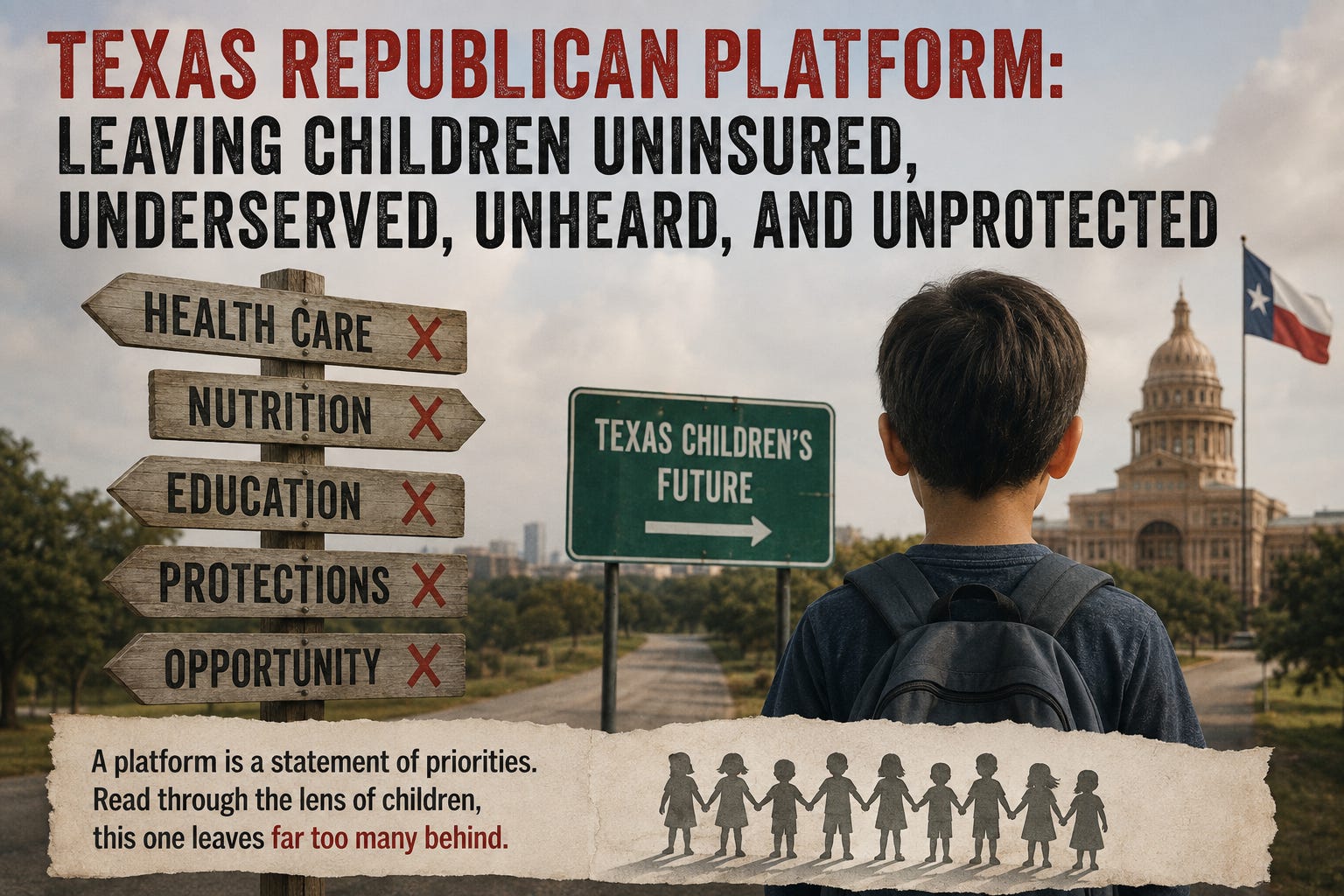
Where Texas Kids Stand Today
Before getting into the platform itself, it’s worth establishing the baseline that this platform would be built on and why we should all be concerned.
First, Texas is home to roughly one in every ten children in America. When Texas succeeds and the State’s children thrive, the nation benefits. When Texas leaves children behind, it pulls down national progress on children’s health, education, nutrition, and economic security. The future of America’s children cannot be separated from the future of Texas’s children.
Unfortunately, Texas isn’t starting from a position of strength for children – it’s starting from close to the bottom on nearly every measure that matters.
Overall Well-being Is 44th in the Nation: The Annie E. Casey Foundation’s 2026 KIDS COUNT Data Book — the gold-standard annual assessment of child well-being, scoring states across economic security, education, health, and family/community indicators — ranks Texas 44th overall, tied with Oklahoma. Only Nevada, Alaska, Louisiana, New Mexico, and Mississippi rank lower.
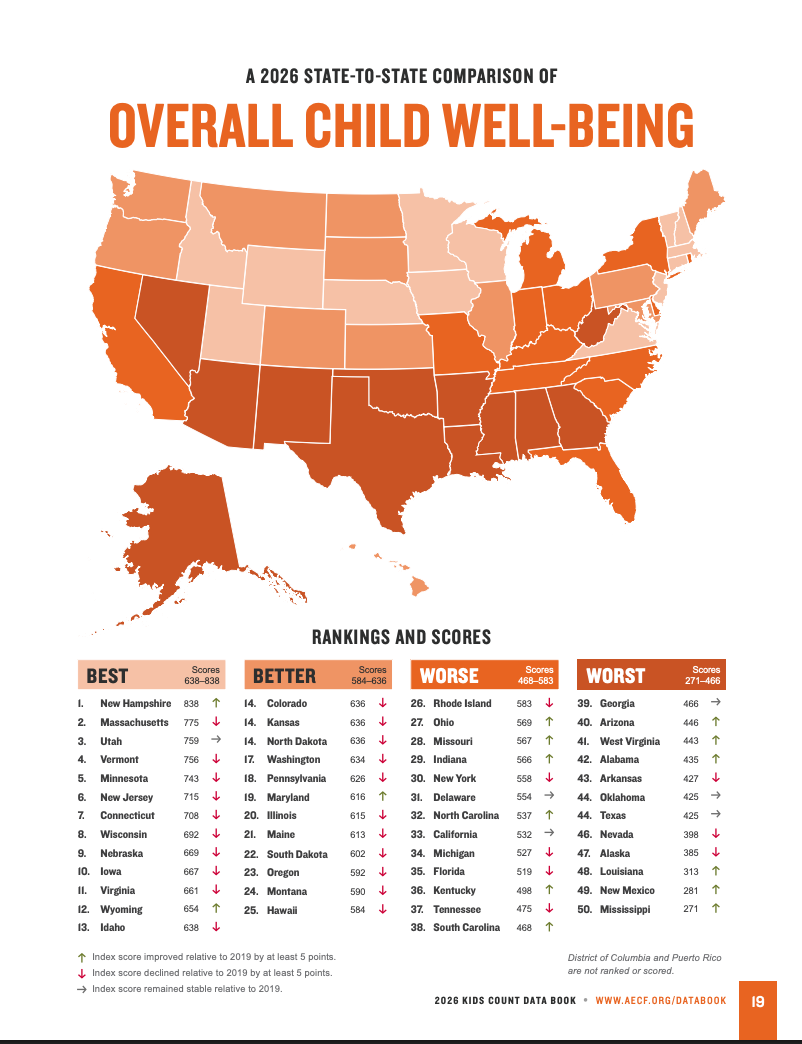
Uninsured Children Rate Is Worst in the Nation: More than 1.1 million Texas children — nearly 14% of the state’s child population — lack health insurance coverage, the highest rate of any state in the country.
Child Poverty Is Well Above the National Average: The same 2026 report found Texas child poverty rates remain well above the national average, one of the core drivers of the state’s low overall ranking.
School Funding Is Among the Worst-Funded Systems in the Country: Per-pupil spending for Texas public schools was about $12,300 in 2023 — 26% below the national average and the 10th-lowest figure among all 50 states, according to a Federal Reserve Bank of Dallas analysis of Census Bureau data. Even after the Texas Legislature’s 2025 funding increase, per-pupil spending remains roughly $4,000 below the national average, leaving Texas in the bottom 10 nationally.
Hunger – Texas Is the Most Food-Insecure State in the Country: According to Feeding America’s 2026 Map the Meal Gap report, Texas has surpassed California for the third consecutive year as the state with the most people experiencing food insecurity, with an overall food insecurity rate of 19.4% — more than 6 million Texans. The child-specific numbers are worse: Texas’s child food insecurity rate is 26.1%, meaning nearly 2 million Texas children — roughly 1 in 4 — face hunger, up sharply from 22.2% just a year earlier.
Texas’s Child Protective Services Fails Children: Through extensive research by Texas Public Radio, the Pulitzer Center, and Story Reach U.S., they found:
Hundreds of children die in Texas each year from abuse and neglect. In an effort to preserve families, the state has employed several policies and laws intended to reduce the number of kids entering the system for various reasons — at times with grave results. Simultaneously — rather than bolster services to keep children safe — the state narrowed eligibility rules to access them, rejecting families in record numbers.
Texas has failed in protecting children from child abuse so badly that U.S. District Court Judge Janis Graham Jack had to reprimand Texas child welfare leaders in court: “There are children dying and being injured on your watch. You want to protect the providers and not the children. This is a pattern.”
These poor rankings and outcomes for Texas’s children are the context in which the platform’s provisions on health coverage, education, nutrition, and child poverty land.
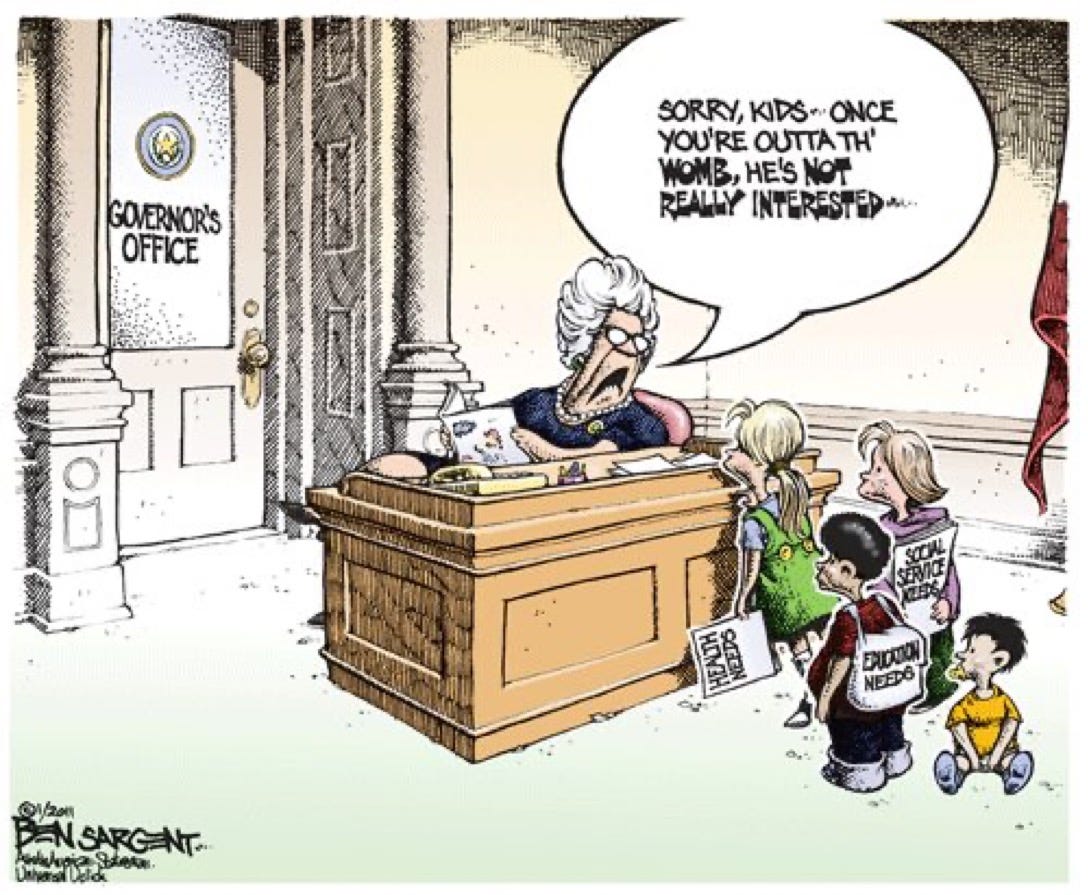
One of my favorite Ben Sargent cartoons in the Texas Observer perfectly captures the status of children in Texas.
I. Children’s Health
Medicaid
This is the section of the platform I want to spend the most time on, because the stakes for Texas kids specifically are enormous.
Plank 136 calls for building a state health savings account “sufficient to exit the federal Medicaid program” altogether, and — until that happens — “we support Medicaid block grants to the states.”
Here’s the problem in plain numbers. Texas already has the worst rate of uninsured children in the entire country — more than 1.1 million kids or nearly 14% of the state’s child population lack coverage.
According to UnidosUS, 80% of uninsured Texas kids are already eligible for but unenrolled in Medicaid, the Children’s Health Insurance Program (CHIP), or ACA Marketplace coverage. Therefore, coverage should be simplified rather than made more bureaucratic and difficult to obtain.
Unfortunately, an arbitrary cap on federal Medicaid funding through a block grant would cut federal spending on children’s coverage by hundreds of billions of dollars nationally over a decade, forcing states to either raise their own spending substantially or ration care through tighter eligibility, reduced benefits, and longer waitlists.
A capped federal block grant would also likely disproportionately harm Texas because it:
Permanently locks federal funding to Texas at lower levels of Medicaid spending per child than the nation as a whole.
Fails to adjust for demographic changes, which would disproportionately harm Texas well into the future, as Texas is one of the fastest growing states in the country.
Fails to adjust for economic downturns.
Fails to adjust for any public health crisis, including the current measles crisis.
Fails to adjust for medical breakthrough, such as a cure for pediatric cancer, cystic fibrosis, or an array of other health care conditions facing children.
Fails to adjust for natural disasters, which would also negatively impact the state, as it is highly susceptible to hurricanes, tornadoes, wildfires, flooding, and other natural disasters.
Over three decades ago, Sen. Bob Graham (D-FL) explained why natural disasters are just one example as to why arbitrary Medicaid caps are unworkable:
Under block grants, a State that is knocked down to its knees by a flood, earthquake, hurricane, would not find a helping hand from the Federal Government at the time it needed help to get back on its feet. No, Mr. President, acts of God and block grants do not mix.
These words hold true today.
Furthermore, Medicaid and the Children’s Health Insurance Program (CHIP) together cover half of the nation’s children nationally, nearly 80% of children living in poverty, nearly half of the 13 million children with special health care needs, and almost all of the children in foster care. A funding cap arbitrary rations care for the kids who most need it.
Compounding the harm, the platform’s call for exiting Medicaid altogether would be a withdrawal from the primary financing structure that keeps Texas children covered at all, replaced with literally nothing other than some vague notion of a health savings account (HSA) that is not remotely comparable in scale or durability to the coverage children receive via Medicaid.
Texas children look to the State’s adults to protect their health and well-being, but this platform proposal is a complete abdication of such protection. As former Texas Governor Ann Richards used to say:
You can put lipstick on a pig and call it Matilda, but it’s still a pig.
The gutting of maternal and child health coverage: Plank 141, titled “Medicaid Reform,” opposes any Medicaid expansion and explicitly opposes “Medicaid for noncitizens,” while calling for funds to be redirected toward “genuine biological medical needs” tied to “good preconception care, good birth outcomes, and good maternal health in Texas.”
Texas has a real program built on this framework: It’s called CHIP Perinatal, which covers prenatal care for pregnant women, regardless of their immigration status, by acknowledging that both women and “unborn children” have improved health outcomes and reduced levels of maternal and infant mortality rates.
Texas’s pro-life community pushed for its adoption, and yet, the Texas Republican Party’s platform is effectively calling for its repeal in:
Plank 7(e), which calls for eliminating birthright citizenship.
Plank 272, “Aid to Illegal Aliens,” which calls for prohibiting any federal or state funding to “any entity or organization that provides material aid or benefit to illegal aliens.”
These two planks would effectively eliminate Texas’s own CHIP Perinatal care standard and maternal and child health coverage policies.
In addition, for the tens of thousands of children that would be newly deemed undocumented or stateless by eliminating birthright citizenship, those children in need of care for cancer, asthma, or care for preventable and communicable diseases would now be denied basic care and services, even for life-saving health care, if the platform were adopted.
Repealing the ACA, in the state with the worst coverage numbers in the country. Plank 143 demands the immediate repeal of the Affordable Care Act in favor of unspecified “free-market principles,” with only a passing nod to preserving preexisting-condition protections. It’s worth restating the baseline one more time: Texas already has the highest uninsured rate in the nation for both children and adults, and Texas is a non-expansion state, meaning it never took the ACA’s Medicaid expansion in the first place.
Repealing the ACA would exacerbate the State’s core uninsurance problem by also eliminating the Marketplace subsidies that are currently one of the only paths to coverage for many Texas families, who don’t qualify for Medicaid and don’t get insurance through work. This plank actively reducing the tools available to address Texas’s uninsured crisis for children.
Home and community-based services (HBCS) is a Medicaid program. Plank 144 calls for “full funding” of HCBS for people with disabilities, as an alternative to institutional care. Here is a positive goal, as HCBS keeps kids and adults with disabilities in their homes and communities instead of institutions. That’s a genuinely good policy.
However, HCBS is delivered almost entirely through Medicaid. Failing to even recognize the contradiction, the Texas GOP platform wants to shrink Medicaid to a block grant, cap its federal financing, and ultimately exit the program altogether. You cannot both starve the funding stream and fully fund the service it pays for.
Again, no state starts farther behind than Texas. That makes this platform’s call to cap and ultimately abandon Medicaid uniquely dangerous for Texas children.
Vaccines
Plank 130 specifically bars any entity — public, private, medical — from conditioning access to school, child care, or public benefits on vaccination status, “including in an emergency or in a pandemic.”
Combined with Plank 133’s mandate that all mRNA-containing medications and vaccines carry special warning labels, this is not neutral language. It’s advocacy solidly against immunizations, which are the biggest public health success story in reducing childhood mortality from preventable disease in generations.
This anti-vaccine plank is being proposed in the midst of a measles epidemic that is harming children all across the Lone Star State and the nation. For example, measles in an infant can result in permanent hearing loss, pneumonia, blindness, brain damage, and even death.
Consequently, even the nation’s biggest spreader of anti-vaccine misinformation, Department of Health and Human Services (HHS) Secretary Robert F. Kennedy, Jr., said to Dana Bash on CNN’s State of the Union:
Parents should get their children vaccinated for measles. A measles vaccine is effective, it stops measles in about 97% of the cases. People should get vaccinated.
In this instance, the Texas GOP should heed his words.
Children’s Mental Health
The platform’s opposition to school-based mental health access isn’t a single plank — it’s a theme, repeated three separate times in three separate sections:
Plank 96 calls for eliminating “universal mental health surveys, screenings, and psychological assessments” and imposes opt-in consent requirements so sweeping they would functionally end school counseling access for many kids.
Plank 137 goes further, calling for abolishing the Texas Child Mental Health Care Consortium and school-based mental health providers outright.
And Plank 146, in the platform’s dedicated Mental Health section, restates it again, explicitly demanding the Legislature “ban all psychological or mental health questions, instruction, activities, surveys, and check-ins in any capacity in public schools.”
That’s not incidental repetition. It’s disturbing that its a priority of the Texas GOP to make mental health services to children far less accessible, and it’s happening in the middle of a well-documented youth mental health crisis.
Removing school-based access doesn’t reduce need — it just removes the one point of contact many children have with any mental health support at all.
Parental Control Over Child Health Up to Age 26
Plank 127 extends parental rights over medical information, grades, and records to dependent children up to age 26.
Plank 129 goes further still, demanding “informed parental consent for all medical care and counseling for all minors“ — full stop, no carve-outs for children seeking cancer treatment, mental health counseling, substance abuse treatment, treatment for physical or sexual abuse by a parent, first aid, broken bones, or immunizations. There is no exception structure.
Parental involvement in a child’s health care is a good and important thing. Treating a minor — or, functionally, a young adult approaching their late twenties — as having no independent standing to access basic care or counseling is a different thing entirely, and it inverts a principle that children are independent rights-holders and not solely the property of their parents.

II. Education
The Texas GOP’s education planks (91–117) are numerous and have enormous implications for Texas’s 5.5 million students. Here are 10 of them:
Abolishing Property Taxes – A Direct Hit to Public Schools: Planks 79 and 80 call for eliminating the property tax system entirely within five years. Local property taxes are the backbone of Texas public school funding. The platform offers no credible substitute mechanism at anywhere near the scale required — and explicitly rules out an income tax as an alternative. However this is dressed up, the practical effect on already-strained Texas school districts, and the children sitting in their classrooms, would be severe.
“Nanny State” and the Assault on Pre-K Programs: Plank 98, styled “Nanny State,” argues children “should not be institutionalized at the age of 4 or 5” and calls for pushing pre-K and kindergarten out of public schools. This flies in the face of a large, long-standing, and growing evidence base on the value of quality pre-K for school readiness and long-term outcomes, particularly for lower-income kids who most need it.
Opposing Social-Emotional Learning (SEL): Plank 103 opposes SEL programs in schools, running against research showing SEL supports academic achievement and reduces behavioral problems.
Opposing STAAR Standardized Testing: That same plank also calls for replacing the STAAR standardized test, which I agree with, but with a broader assessment system. I’ve written critically about NAEP misuse and the perverse incentives of high-stakes standardized testing regimes.
A Veiled Attack on Plyler v. Doe: Plank 104 asserts that “the role of the public education system is to educate American citizens” and opposes allowing undocumented children into public schools — a direct challenge to the Supreme Court’s 1982 holding in Plyler v. Doe that states cannot deny a free public education based on immigration status. Whatever one thinks of immigration policy generally, Plyler rests on the fundamental rights of all children to receive an education and a recognition that punishing a child for their parents’ immigration status, by denying them an education, harms both children and society. This plank would reopen that fight, with children as the casualties.
A Disturbing Irony on Curriculum on Reproductive Health: Plank 107 mandates detailed instruction on the “concept that life begins at fertilization” and “witnessing a live ultrasound” while Plank 94 elsewhere bars nearly all instruction on “sec education, sexual health, or sexual choice or identify in any government school or any grade whatsoever.” A platform that wants schools teaching about pregnancy and fetal development in exacting detail, while banning nearly any instruction on the reproductive and sexual health topics that precede pregnancy, serves an ideological rather than a health purpose.
A Surprising Acknowledgment of Student Rights: In contrast and as noted in the opening section of this newsletter, buried at the end of that same Plank 107 is a requirement for age-appropriate education on students’ rights and safe reporting channels for forced marriage, female genital mutilation, honor violence, grooming, and trafficking, with protection from retaliation for reporting. This is genuinely good, protective policy, and it deserves to be said plainly: children are safer where student rights are a part of public policy.
Abolishing the Department of Education and Everything It Funds: Plank 108 calls for abolishing the U.S. Department of Education and explicitly bars the transfer of its functions elsewhere. Make no mistake about what “abolish, don’t transfer” actually means in practice: it means the end of Title I funding for low-income schools, the end of federal enforcement of IDEA for kids with disabilities, the end of federal civil rights enforcement in schools, and the end of Title IX protections for girls. This is the elimination of the primary federal levers protecting the most vulnerable kids in the system.
Gagging the People Who Advocate for Children: Planks 114 and 115 restrict school districts and administrators from any lobbying or legislative advocacy without board pre-approval, effectively muzzling the institutional voices most likely to speak up for children in the legislative process. Children cannot vote, cannot lobby, and cannot organize a PAC. The adults and institutions around them — teachers, school boards, administrators, coaches, counselors, school nurses, etc. — are needed advocates for children have in the political process. Silencing those advocates doesn’t protect children. It isolates them further from lawmakers who are often indifferent to their interests.
Abolishing School Health Programs: Plank 117 calls for defunding and abolishing the Texas Department of State Health Services School Health Program — on top of the mental-health-specific planks (96, 137, 146) already discussed above. Between all of these, the platform takes direct aim at nearly every institutional channel through which Texas kids currently access basic health and mental health support at school.
III. Social Services
The platform calls for the abolition of important programs for our nation’s children:
Abolishing Federal Welfare Programs: Plank 138 calls for the “abolition of all federal welfare programs,” framing state and faith-based charity as the interim substitute. Combined with the minimum wage and family leave repeal above, this plank removes both the wage floor that keeps working families afloat and the safety net meant to catch them when work alone isn’t enough — a one-two punch that lands hardest on the children in those households, who have no say in either policy and no independent means to make up the difference. Child poverty, which negatively impacts every aspect of the lives of children, would rise exponentially.
Eliminating Minimum Wage and Family Leave: Plank 28 calls for repealing federal minimum wage and prevailing wage laws and eliminating mandatory sick and family leave, at both the federal and state level. Child well-being researchers have spent decades establishing the link between family economic security and child outcomes — nutrition, housing stability, school readiness, and health care. A parent who can’t take paid leave when a child is sick, or whose wages are pushed below subsistence, isn’t gaining “freedom.” Their children are losing ground. This is organized abandonment of fundamental needs of children and families dressed up as deregulation.
Child poverty, hunger, and homelessness are policy choices. This platform makes the wrong choices for children.
IV. Immigration
The immigration sections of the platform would negatively impact the lives of a large number of Texas children – whether they are citizens, legal immigrants, or undocumented. Those provisions include:
Stripping Citizenship from Babies: Plank 7(e) calls for amending the 14th Amendment of the Constitution so that citizenship is granted only to children with at least one parent who is already a U.S. citizen — eliminating birthright citizenship for everyone else. As noted above, this targets harm to innocent babies and would create a permanent class of American-born children who are, by design, stateless. A baby has no say in where or to whom she is born. Punishing a newborn for it — stripping them of the single legal status that determines their access to nearly everything else in life — is about as pure an example of organized abandonment as exists in American law.
A Census That Would Undercount Texas Itself: Plank 16 calls for excluding “illegal aliens and noncitizens” from the census. This is flatly inconsistent with the constitutional text, which calls for an actual enumeration of persons — not citizens and not voters, but persons — every ten years. It’s also not operational. How, precisely, would Census workers verify the citizenship status of a household, including the children in it, door to door? There’s no mechanism. And the irony is that Texas would be shooting itself in the foot: an undercount shrinks the state’s congressional apportionment and its share of federal formula funding for years to come, hurting every Texan, child and adult, citizen and noncitizen alike.
The Rest of the Immigration Section Targets Kids Too. Plank 7(e)’s attack on birthright citizenship isn’t isolated — the platform reinforces it twice more, and each time the target becomes more explicitly a child.
Plank 266(b), tucked into a list of measures meant to “eliminate illegal immigration magnets,” calls on the State of Texas to “refuse to grant a birth certificate to any child born to illegal alien parents on Texas soil.” This is a state-level attempt to accomplish, by administrative refusal, the fundamental right of citizenship to infants, despite the clear language of the Constitution’s Citizenship Clause. A newborn denied a birth certificate isn’t just denied citizenship paperwork. They are denied the single document that unlocks a passport, a Social Security number, health and nutrition services, and proof of identity for the rest of their lives. There is no version of this plank that doesn’t fall entirely on innocent children who had no part in the policy decisions of their parents or their government.
Then there’s Plank 272, “Aid to Illegal Aliens,” which calls for prohibiting any federal or state funding to “any entity or organization that provides material aid or benefit to illegal aliens,” with tax-exempt status and business licenses revoked for violators. Every Catholic Charities affiliate food pantry, legal clinic, mobile health van, or an immigration services desk would be targeted. Every pediatric clinic or public health department that vaccinates a child regardless of status. Every legal aid nonprofit that provides a lawyer to a child in immigration proceedings — including the unaccompanied minors who, under existing law, don’t automatically get appointed counsel and depend entirely on nonprofit legal aid to have any advocate in court at all. Every water utility and food bank that doesn’t check papers before it turns on the tap or hands over a box of groceries. As written, it puts all of it at risk, and the institutions most exposed — churches, charities, legal aid clinics — are disproportionately the ones serving children directly.
V. Children’s Rights
Despite the positive reference to student rights in Plank 107, the rest of the platform threatens children’s rights repeatedly:
A “Single Age of Majority” That Erases Children’s Actual Rights: Plank 13 calls for “a single age of majority on which, when reached, all citizens will be guaranteed their rights, duties, and privileges.” However, children hold rights now – due process rights, free speech rights, rights under the 4th Amendment, a right to education, rights as crime victims and as patients — that don’t spring into existence magically on a child’s 18th birthday. Children are not future citizens. They are citizens now, with a developmentally appropriate but very real set of protections.
Parental Rights Language That’s Already Redundant and Getting More Extreme: Texas has already passed a parental rights constitutional amendment but Plank 18 nonetheless calls for another one, and Plank 91 pairs it with sweeping language making parents “the primary educators and disciplinarians of their children, to which all other entities are inferior.” I’ve written before about the real Texas parental rights law and its problems. Parental involvement in a child’s life is a good and important thing. But this platform, read alongside the age-26 medical consent provisions discussed in the Children’s Health section above, consistently treats children as objects of parental authority rather than as independent rights-holders in their own right.
No-Fault Divorce – Solving a Problem That Isn’t There, at Children’s Expense: Plank 211 calls for rewriting the Texas Family Code to unwind no-fault divorce, extend the mandatory waiting period for a divorce to six months after filing, and require intervention or counseling before any divorce decree can be granted. This is the wrong fix for family stability. No-fault divorce didn’t create family conflict — it gave courts, and children, a faster, less adversarial off-ramp out of what can be abusive and dangerous relationships. Mandatory extended waiting periods and forced counseling don’t heal marriages that both parties have already decided to end; they mostly just extend the period during which children live inside active parental conflict, and in cases involving abuse, they can trap a parent and children in a dangerous household for months longer than necessary. If the goal is genuinely child welfare, the evidence doesn’t point toward reversing no-fault divorce. It points toward better-funded family courts, custody mediation, better-trained and better-paid caseworkers, and support services for families — none of which this plank offers.
VI. Common Thread: Organized Abandonment
In total, the platform’s vision is one of “organized abandonment” for children and families, including:
Cuts to public investments and supports (Medicaid, SNAP, property taxes, welfare programs, the ACA are all slashed by the various planks).
Cuts and undermining of the public institutions that serve children directly (public school funding, school-based health programs, public health, school meals).
Restrictions on the legal status and documentation that determine whether a child can access care and services (attacks on birthright citizenship, prenatal care, birth certificates, aid to children in mixed-status households).
And simultaneously restrict the mechanisms (school advocacy, federal oversight, judicial protections like Plyler, even the off-ramp of no-fault divorce) that might otherwise catch and protect children.
Throughout the platform, the planks paradoxically speak about empowering parents while systematically dismantling many of the institutions that parents themselves depend upon to raise children. Parents deserve respect, but they also deserve functional schools, accessible health care, public health, safe communities, and economic security. One without the others is not empowerment – it is the very definition of “organized abandonment” of children and families.
This does not happen because all of the platform authors overtly hate children. It happens because children can’t vote, can’t organize, and can’t show up at a committee hearing to object. Consequently, children are invisible in the process and, structurally, the easiest population in American politics to deprioritize and subjugate. Platforms like this one are what deprioritization looks like when you put pen to paper.
Instead, imagine a platform that asked of every plank: Is it good for the children? Does this leave children healthier? Safer? Better educated? More economically secure? More likely to flourish and thrive?
Texas may disagree on taxes, immigration, or abortion, but they should be able to agree that children deserve to inherit stronger opportunities than the generation before them. Texans are proud of their State and should demand from their political leaders better than a ranking of 44th in child well-being for their children.
With one in every ten American children calling Texas home, the stakes extend far beyond the state’s borders. The choices Texas makes today will help determine the future well-being of children across America.
There are a handful of planks here I’d defend — the anti-trafficking and anti-FGM education language, the STAAR criticism among them. Good policy sometimes shows up in unexpected places, even in documents that largely fail children.
However, overall, the various planks in this platform reveal a pattern that, when difficult choices arise, children repeatedly are ignored, subjugated, or outright harmed.
As a result, if adopted, the governing philosophy of the Texas Republican platform would leave Texas children more uninsured, more underserved, more unheard, and more unprotected than they already are.
As we approach 90 days before election day on November 3, 2026, Republican leaders should be asked to support better policies that are supportive of children and families. Gov. Greg Abbott and others have led the state for years and years, and yet, Texas ranks a pathetic 44th in child well-being. They should be asked to explain how they will do better for Texas kids.
Democratic leaders should be asked to put forth a better vision for the future of children, families, and Texas’s future. They should tell voters how they will take action to ensure Texas children no longer lead the nation in uninsured rates, how schools will be better funded and supported, how they will ensure Texas no longer leads the nation in food insecurity, and how to fix the Lone Star State’s horribly broken child welfare system.
Elections are about the future. In Texas and all across the country, kids can’t wait.
#VoteKids