


Start with what nearly everyone in this fight agrees on.
We all want children to learn to read, write, and reason. We want to know how they’re doing – with most of us wanting to know it for every child, and not just our own child. Most of us want school to be a place where children are known, challenged, and given some reason to believe the effort will be worth it. And finally, most of us believe that all children can learn with some needing supports to overcome challenges they face through no fault of their own.
That is a broad consensus. It spans the political left and right, unions and reformers, and — as the evidence below shows — parents and kids alike.
Notice two things I left off that list: standardized testing and accountability.
Standardized testing was never the goal. It has been a somewhat terrible proxy — a rough, narrow, deeply flawed stand-in for the things we do want. And yet, school quality, teacher effectiveness, district leadership, and even children’s futures increasingly came to be judged through standardized test scores.
But no parent sends a child to school hoping they become experts at filling in bubbles and writing “brief constructive responses.” We tolerated the tests because we were told they were the price of knowing how children were doing. That was always a bargain, never a value. And they were built upon a very troubling historical purpose that is still part of the system.
Before asking whether we should preserve that system, we should ask a more basic question: did it actually deliver what it promised?
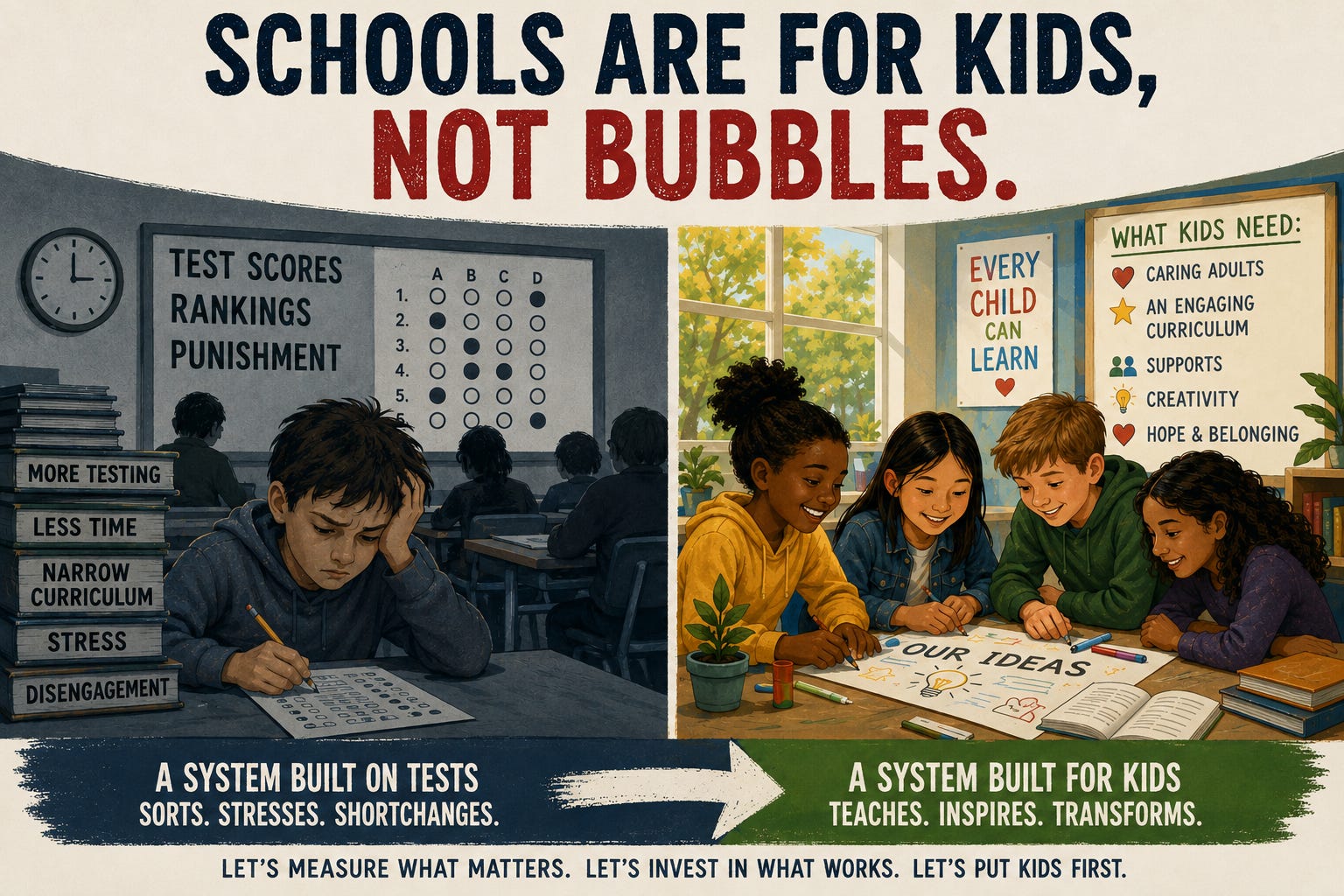
Ross Wiener: A Testimonial That Should Be Taken Seriously
Ross Wiener — the policy director at the Education Trust from 2002 to 2009, who testified before Congress and built coalitions to advance No Child Left Behind (NCLB) — published an op-ed in the New York Times last month arguing that the standardized testing and accountability apparatus has failed to deliver. The headline was a recanting: “I Thought ‘No Child Left Behind’ Would Fix Public Schools. I Was Wrong.”
That’s an important revelation. Wiener helped build this architecture with the right intentions, as genuinely believing it was the path for public schools to better serve low-income students and students of color. And his honest assessment of the results, as he looks back on its history, is:
Over time, I became convinced that, with the best of intentions, I and many others in the education reform community had transferred our moral commitment to children over to the standardized tests. We had done this earnestly, not cynically, but we still did damage (emphasis added).
Although he has his critics, Wiener is right.
After a quarter century of treating a narrow, poorly labeled, demonstrably biased metric as the primary answer to every question about children’s learning, the apparatus has fallen far short of what students and educators deserve and need.
The conditions that actually determine whether kids can be helped to learn, including equitable funding and poverty reduction, often went unfunded and unaddressed. Wiener’s naming of the failure of standardized testing and accountability measures built upon it is important, particularly from someone inside the movement that initially believed in it.
Wiener explains that his disillusionment with the focus on standardized testing as a “savior” began early in his career as he came across research showing that high school grade point average (GPA) predicts college graduation better than standardized test scores.
He went to his boss at the time, expecting her to help him push back, but she confirmed it was true and had always been. GPA is based on assessments that are more closely tied to mastery of a variety of subjects – not just reading and math.
Other measurements, such as that by University of Chicago Consortium research, have also found that a school’s effect on students’ social well-being and work habits predicted long-term outcomes — graduating high school, enrolling in college, staying out of the criminal justice system — about as well as test performance, and better for some of those outcomes. The thing accountability policy made the organizing principle of American schooling wasn’t what mattered most for kids’ futures.
More importantly, Wiener lays out the human cost to children. In 2023, he notes that 40% of high schoolers reported persistent sadness or hopelessness; one in five had seriously considered suicide, and nearly one in ten had attempted it. Of course, nobody is saying standardized testing is entirely to blame for the mental health crisis facing kids, but it contributed to the stress kids face, and the reporting of students that “drill and kill” curriculum that has been built around it is boring and irrelevant.
Wiener’s claim isn’t that testing caused all of that, but that the bargain American schooling relied on — “comply with adult-designed systems, defer questions of meaning and purpose, and the payoff will come” — has broken down, and a generation that no longer extends that trust, meaning, and purpose isn’t going to be reached by more compliance pressure.
As Wiener explains:
You cannot accountability-pressure your way to better educational outcomes when chronic absenteeism has skyrocketed, misbehavior is common, students are disengaged and skeptical that school prepares them for the lives they want to lead, and teachers feel not just tired but stripped of the professional trust that makes the work meaningful.
The public gets it, even if politicians and many in the “reform movement” can’t seem to accept any alternative or are so invested in the structures or the ideological gains that can be exploited. In a survey in which Populace asked adults to rank their K-12 priorities, standardized test performance ranked 49th out of 57 measures.
While the public rejects standardized testing as a priority, it’s important to note that other assessments were embraced, as teacher-administered exams ranked 10th, real-world application assessments ranked 19th, and class-based projects ranked 22nd.
Populace’s own framing is explicit that the objection isn’t to exams, but to standardized tests specifically. The people raising and teaching these children have told researchers, consistently and unprompted, that ranking kids against each other on test scores is close to the least important thing they want school to produce.
For a generation, the reform coalition took its validation from economists and accountability metrics, while treating parents, students and communities as mere functionaries rather than partners in a shared civic enterprise.
Federal policy’s original role in education has been lost but should be restored, according to Wiener. He writes:
Federal policy has an essential role to play in public education: protecting civil rights, funding quality data and research, and encouraging promising practices to spread. But the formative mission cannot be mandated by Washington. Belonging, the foundation of both learning and civic commitment, is relational and starts local; it cannot be standardized or scaled, but must be cultivated by schools that are responsive to the communities they serve.
And, over several decades, standardized testing has come to mean something that is often punitive: labeling schools as failing, ranking teachers by their students’ scores, and, in more than thirty states, authorizing officials to seize control of school districts outright – all based on standardized testing.
On this latter point, roughly 85% of state takeovers have hit majority-Black and majority-Latino districts. And the research is unambiguous about what they accomplish: a national study of takeovers between 2010 and 2018 found no meaningful gains in reading or math even a decade later, with some evidence that reading performance was actively disrupted in the early years.
Houston is the current example — the Texas Education Agency took over the eighth-largest district in the country on the strength of just one campus’s test scores, after the district’s own accountability grades had been improving and the trigger school itself had passed.
That’s part of the regime as actually built around standardized testing: a proxy measure that mostly just tells us who is wealthy and who is not, enforced by a punitive apparatus that did not deliver the learning it promised, and that fell hardest on the communities with the least political power to resist it.

Unfortunately, when people defend standardized testing “accountability” in the abstract, this is the machinery they are defending, whether they mean to or not.
So, the real question isn’t whether adults should answer for how children are served. It’s whether the machinery that was built in the name of that principle actually serves children. For decades now, the answer to many of the questions about American schooling has run through standardized test scores — not as one input among many, but as the organizing principle: what gets funded, what gets taught, which schools get called failing, which districts get taken over, which children get told they’re behind, and what perverse incentives are built around them.
That’s a specific policy choice, and it’s fair to ask what it delivered and what disasters it has created (whether intentional or not).
The “Decline” Is Not What They Say It Is
Almost every argument for doubling down on more testing rests on a premise that deserves more scrutiny than it gets: that “American kids are in academic freefall.” Note what’s happening: standardized test results are being used to justify adherence to a regime of standardized testing. A gap, generated in part by the measurement itself, cannot be closed by more of the measurement.
That is the pure definition of circular reasoning and justification.
It is also an embrace of a regime that educator Peter Greene describes as, “If that idea failed, then we should get back in there and fail harder.”

It is like the era when the health care system continued to call for the repeated bloodletting of patients after previous courses of bleeding had failed.
Then there’s the measurement itself. Many of the dispersions and attacks on the education system are built upon “cut scores” and NAEP “proficiency” mislabeling. NAEP’s achievement levels were never meant to signal grade-level performance — the National Center for Education Statistics (NCES) says so explicitly — yet officials in both parties routinely cite “only a third are proficient” as proof of catastrophic failure.
What has been catastrophic has been the false interpretation.
As I recently noted, researchers Gina Cervetti and Kathleen Hinchman mapped every state’s own definition of fourth-grade grade-level reading directly onto the NAEP scale and found that nearly every state’s standard lines up with NAEP’s Basic level, not Proficient. Read correctly, that means roughly two-thirds of American fourth graders are reading at or above grade level — the opposite of the headline.
What the data actually shows isn’t a system in freefall. It’s a persistent, decades-old equity gap: only 48% of low-income students scored at or above Basic in 2022, compared with 76% of their better-off peers. That is a story that is much about poverty, housing, health care, and school funding and not as much a measure of educational system successes or failures.
This demands that everyone be more careful about building sweeping policy arguments on top of a metric this unreliable. The cut scores in many standardized tests are judgment calls, not fixed points in human learning. The tests’ content carries documented cultural and geographic bias. As Greene argues:
…one of the biggest frauds perpetrated in education policy and journalism is the continued use of “student achievement” as a euphemism for “test scores.”
A decade ago, Pennsylvania teacher Steven Singer pointed out that these tests are rarely designed to find out what children have learned, but instead, are designed simply to create a bell curve. Therefore, they systematically and quite purposefully discard questions that actually measure what teachers most want children to know. This design has racial, cultural, wealth, and geographic consequences.
Emory’s Martin Shapiro has pointed out that when test makers keep the items that produce the widest gap between high and low scorers, they are selecting against minority students almost by definition — if a question is retained because the majority got it right, the students who got it wrong are disproportionately the minority. Field testing then locks this in: a question most white students answer correctly and most Black students miss survives, because white test-takers are the larger group.
The result, as education researcher Wayne Au describes it, is a self-reinforcing loop: item selection is calibrated to match existing racial score gaps, which locks those same gaps into every future version of the test, all without anyone ever explicitly considering race in the selection criteria. A question drawing on Black cultural experience would fail field testing for the same reason.
Consequently, the very act of “test norming” causes questions drawing on cultural experiences that cause children of color to score better than white children are tossed. This is referred to as “cultural validity,” the idea that a test cannot cleanly distinguish what a child knows from what a child has been exposed to.
In 1972, the psychologist Robert Williams developed a test called the Black Intelligence Test of Cultural Hegemony, using vocabulary and content drawn from Black American culture rather than the dominant culture’s frame of reference. When Black and White teenagers took it, Black students substantially outscored White students by substantial margins. That, obviously, is not the test that has been administered for the last 50 years.
As education scholar and history professor Andrew Hartman points out:
As a method of social production, as well as social reproduction, standardized testing has had serious cultural implications, not the least of which has been the eternal question of American identity… Consistent with notions of American identity, standardized testing, as an opposition to a cultural other, represents the normalization of whiteness, richness, and maleness (emphasis added).
None of this is hidden. Standardized testing in America was built in the 1910s and 1920s by men — Robert Yerkes, Carl Brigham, Lewis Terman — who were explicit eugenicists using their instruments to argue that Northern Europeans were innately superior. Brigham went on to create the SAT. The overtly racist language is gone. The architecture of sorting is not.
Hartman explains this history:
The early use of standardized testing was an education reform response to the scientific racism and eugenics movements. Early American standardized tests-referred to as intelligence tests-were a method of tracking, classifying, and ordering students.
That history matters not simply because of where standardized testing came from, but because many of the sorting functions it was designed to perform still shape the system today.
And then there’s a structural absurdity of the movement that few acknowledge. Because these tests are normed to a curve, a fixed share of children must always land at the bottom. You can raise scores at one school or one district, but the distribution itself is fixed. We passed a law called No Child Left Behind, and built it on an instrument that mathematically guarantees some children will always be left behind. There was never a version of this where every child succeeded, because the measurement itself would not permit it.
President George W. Bush explained at the time:
An accountability system must have a consequence; otherwise, it’s not much of an accountability system.
As a nation, we never equalized education funding. Wealthy kids continue to have much better funded schools than low-income kids and that advantage is built into the testing regime.
While standardized testing was formed on the promise of “no child left behind,” in practice, the opposite has occurred. Test scores have been used to justify withholding support for lower scoring schools – to label the school, fire the teachers, take over the school district, and move the money elsewhere.
If a child is struggling, the humane response is more support. However, the system was built to respond with sanctions, and then called the sanctions accountability.
John Oliver captured much of this on his HBO show Last Week Tonight over a decade ago. His revelations have aged well.
Why A Test-Centric System Produces Disengaged Kids
Testing, separating, labeling, and ordering students is devastating at the individual student level as well.
Dr. William Glasser argued that people, including children, are driven by basic needs for freedom, competence, and enjoyment in their work, and that using test scores to constantly rank, shame, or coerce students destroys the intrinsic motivation that produces genuine engagement in the first place.
Glaser was blunt about the institutional version of this failure: making a one- or two-point movement on a test score the primary goal of a school is precisely the wrong goal, and it comes at the expense of building a real culture of quality. He also warned that the right-answer/wrong-answer format of standardized testing teaches children that education is a hunt for a predetermined answer rather than a process of understanding and learning to reason.
That’s the mechanism. Not that accountability directly causes sadness in some abstract sense, but that an institution organized around external compliance with a score starves the psychological needs that make kids want to show up and try. Glasser was describing this failure mode decades before “chronic absenteeism” became a policy term. It isn’t a theory built after the fact to rescue anyone’s argument; it’s an old one that predicted exactly what we are now seeing.
What The Testing Obsession Crowds Out
Curriculum narrowing has consequences we can measure. When school success is defined almost entirely by reading and math scores, everything untested gets squeezed — civics chief among it. A Cato Institute survey this year found 58% of Americans don’t know the Constitution’s core purpose is to limit government power. That’s not a trivia gap. It’s what happens when a generation spends its entire K-12 career under a regime that never made room to teach the things it doesn’t test, including civics. Science, history, the arts, and physical education get pushed to the margins of the elementary day because they aren’t tested and therefore aren’t rewarded. And yet, those teachers are often punished for student test scores limited to math and reading.
And the testing obsession distracts from the things actually keeping kids from learning. As the saying goes, “You can’t fatten a pig by weighing it.” More testing doesn’t feed a hungry kid, insure a sick one, or house a family living in their car — and right now those conditions are getting worse, not better, for millions of American children.
Child poverty, measured by the Supplemental Poverty Measure (SPM), has more than doubled since its 2021 low, from 5.2% to 13.4% in 2024. That has been a policy choice.
Furthermore, nearly one in five households with children, or 14.1 million kids, were food insecure in 2024, essentially erasing a decade of progress. SNAP cuts enacted since then are projected to push that higher, even as the U.S. Department of Agriculture (USDA) has stopped collecting the data that help us track it.
Children’s health coverage is sliding backward too: the child uninsured rate has risen from 4.7% in 2016 to 6.1% in 2024. Compounding that negative trend, roughly two million fewer kids have been enrolled in Medicaid and CHIP since January 2025, with more than $1 trillion in cuts to Medicaid hitting children after passage of the so-called “One Big Beautiful Bill” (OBBB) last year.
A hungry, uninsured, unstably housed child does not learn better because we test him more. If we spent a fraction of the political energy currently devoted to accountability architecture on making sure kids arrive at school fed, healthy, and secure, we would do more for their test scores than another round of mandates ever could and far more for the best interests and well-being of children themselves.
Money Matters
Here is what gets lost in twenty-five years of arguing about mandates. The original civil rights case for federal involvement in education wasn’t only about measuring gaps. It was about closing them, and closing them takes resources.
The research on this is no longer ambiguous. Northwestern’s Kirabo Jackson and colleagues, in a meta-analysis of every credibly causal study on school spending, found that increased funding shows real, positive effects on student outcomes. A sustained $1,000-per-student increase raises high school graduation and college enrollment rates, and low-income students benefit most of all — with measurably higher wages and lower poverty rates in adulthood.
Money matters. It has always mattered more consistently than test-based accountability ever has.
As life-long educator Diane Ravitch explained in her outstanding book, The Death and Life of the Great American School System: How Testing and Choice Are Undermining Education:
Our schools cannot be improved by those who say that money doesn’t matter. Resources matter [and] if we are serious about narrowing and closing the achievement gap, then we will make sure that the schools attended by our neediest students have well-educated teachers, small classes, beautiful facilities, and a curriculum rich in the arts and sciences.
Unfortunately, in recent years, the actual investment has dramatically eroded.
First Focus on Children’s Children’s Budget 2025 shows federal spending on education fell from $78.5 billion in 2021 to $60.3 billion in 2025 — a 16.8% decline in real spending.
President Trump’s 2026 budget has proposed cutting it to just $39.1 billion, or less than half of 2021 levels and nearly two-thirds less than 2022 levels (cuts that are even worse if you account for inflation).
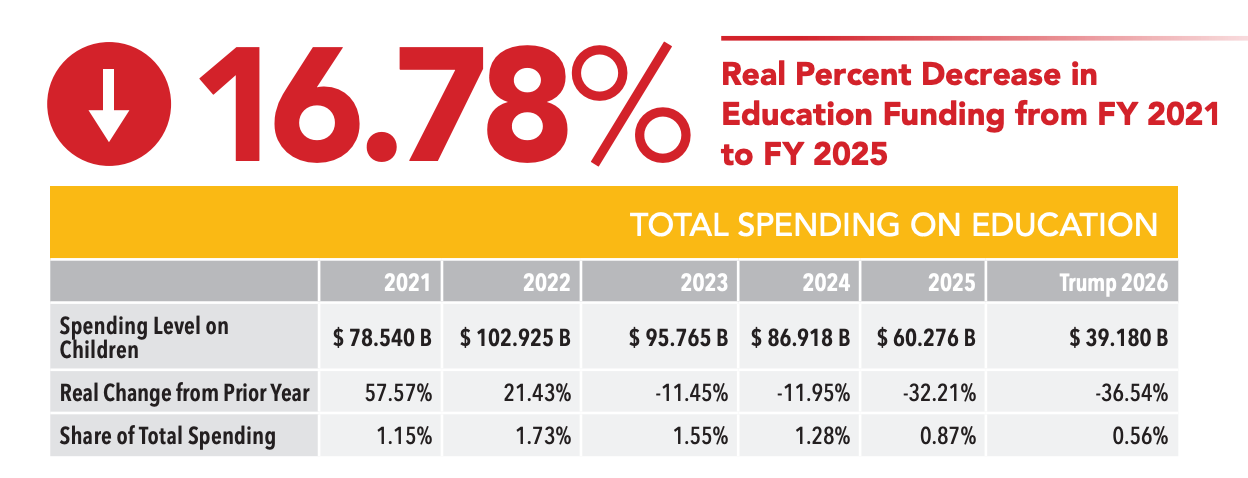
The President’s budget proposals to abolish the Department of Education, slash Title I and IDEA funding, and promote the expansion of voucher programs that redirect public dollars to private schools that carry none of the civil rights protections or accountability requirements public schools must meet are fueling an education funding cliff for our public schools.
Those aren’t neutral shifts. They fall hardest on exactly the children the accountability era claimed to protect: low-income kids, kids of color, and kids with disabilities.
Decades of standardized testing without funding the effort to close identified gaps let accountability function, in practice, as a shifting of blame to schools and teachers of the work that federal and state policymakers have repeatedly failed to address, including ending school funding inequity, concentrated poverty, and segregation.
It is important to note that Wiener and the public are not asking to stop measuring how schools perform. For example, the Populace data ranks teacher-administered exams, real-world assessments, and class-based projects far above standardized tests. It is highly disappointing that the “parental rights” crowd seems to ignore both the real priorities of parents and the related problems associated with disappearing federal investments in children.
Ask The Kids
Ask the children at any school, and they can tell you who the best and most challenging teachers are, which curricula they have found challenging and engaging, and what interests they have and wish to pursue.
And yet, in the school wars, there’s one major voice missing from this entire debate, and it’s their voice.
A Lancet Health Policy paper published this month on the “Children in All Policies” collaboration makes the point directly: children’s right to participate in decisions that affect them is routinely ignored, even by adults who otherwise mean well. One child in a CAP-2030 workshop in Ghana put it bluntly — adults assume kids’ input doesn’t make sense.
Everyone in this argument has been reasoning about what children need from data adults collected. So, what happens when you actually ask the kids?
A Voices of Gen Z study surveyed K-12 students themselves and found fewer than two in ten strongly agree their classwork feels important, interesting, challenging, or aligned with their talents. Ask them what drives engagement when it does show up, and the answers are a teacher who made the material interesting (60%), wanting to learn more about the subject itself (60%), hands-on engagement (46%), and connecting learning to the real world (35%). Test scores appear nowhere on that list — not because kids weren’t asked about testing, but because when you ask children what makes school worth showing up for, sitting for days on end filling in bubbles on a standardized test isn’t motivating and would never be the kind of thing that they would prioritize.
Kids’ own bodies say the same thing, in a study that didn’t have to ask them anything. For example, a study published by NBER measured cortisol in New Orleans students in grades 3 through 8 during high-stakes testing weeks versus ordinary weeks, using saliva samples rather than self-report. What researchers found was that cortisol levels rose about 15% on average during testing weeks, with sharper spikes among boys and among children from higher-poverty neighborhoods. That’s a measurable physiological stress response to the instrument itself.
And when kids get to ask each other, the pattern holds. A youth-led research project in New Mexico had teenage interns survey more than 270 peers about what students should demonstrate before graduating. The answers are: kindness, confidence, respect, integrity, empathy, and community involvement. As one student researcher observed, none of those are things a standardized test measures.
The CAP-2030 evidence points the same direction from another angle. When you bring children into policymaking — through art contests, school parliaments, citizen science projects, structured youth advisory boards — they produce better policy, not just more participatory policy.
We should listen to the kids more, as it is their lives, their education, their health, their well-being, their development, and their safety that this is all supposed to be about.
None of this means handing kids the pen on federal testing policy. It means that children know things no survey of adults can fully capture: which teachers actually reach them, what kind of work makes them want to show up, when they are bored out of their minds and when they are not. We rank adults’ priorities for children 57 ways. We almost never ask the children — and on the rare occasions we do, they tell us the same thing, only more starkly.
The One Question
Every institution whose work affects children should begin with one question: is this good for children?
Apply it here. A system that adults rank 49th out of 57 priorities. That produces record adolescent hopelessness and measurable spikes in children’s stress hormones. That narrows what gets taught to what gets tested. That runs on data the officials citing it chronically misread. That is built on an instrument engineered to discard the questions teachers most want to children to master, and to sort children rather than teach them. That has been used to seize control and accountability away from majority-Black and majority-Latino communities without producing academic gains. That keeps weighing children while their poverty, hunger, and uninsurance rates climb. That lets real investment in disadvantaged kids fall for four straight years. And that still doesn’t bother to ask the children themselves what they need.
Is that good for children? It isn’t close.
Kids need us to ask, honestly, whether the tools we built back then serve the children in front of us now and to spend our energy on the things that actually would, which isn’t more standardized testing.
Our kids can’t wait.
Thank you for brilliantly pulling together this thorough collection of research reports and commentaries documenting the harm that (bad) standardized testing has done and continues to do to children, youth, and their families.
At this time there are only 16 likes to this post and now, two comments, and soon to be 6 restacks. Arghhhh.
I want this piece to be read by every administrator, teacher, parent, and interested student--and most of all, politicians and state and local school board members.
Because schools need money and if they do t do the testing they lose funding!!! It sucks and is ridiculous the amount of time it takes away from teaching anything else, because schools get stuck doing improvement processes if they don’t test well. So it becomes a game of teach to the test. So what’s it about? Money. Somebody is making bank on the testing and the practice tests as well as other textbooks and materials that hit the key standards related to the tests. Bunch of bullshit. The schools have to hold a bake sale to help kids get clothing and supplies while our politicians become multimillionaires.