

Children as Collateral Damage
A Child-Centered Response to the Heritage Foundation's 'Saving America by Saving the Family' Report

Introduction: The Moral Claim
The Heritage Foundation’s latest report, Saving America by Saving the Family, is not a typical policy paper. It is a 164-page proposal to restructure the entire federal government around a narrow vision of marriage and family life. And it presents itself as something more than policy – it presents itself as a moral intervention on behalf of children.
And yes, I read it so you don’t have to.
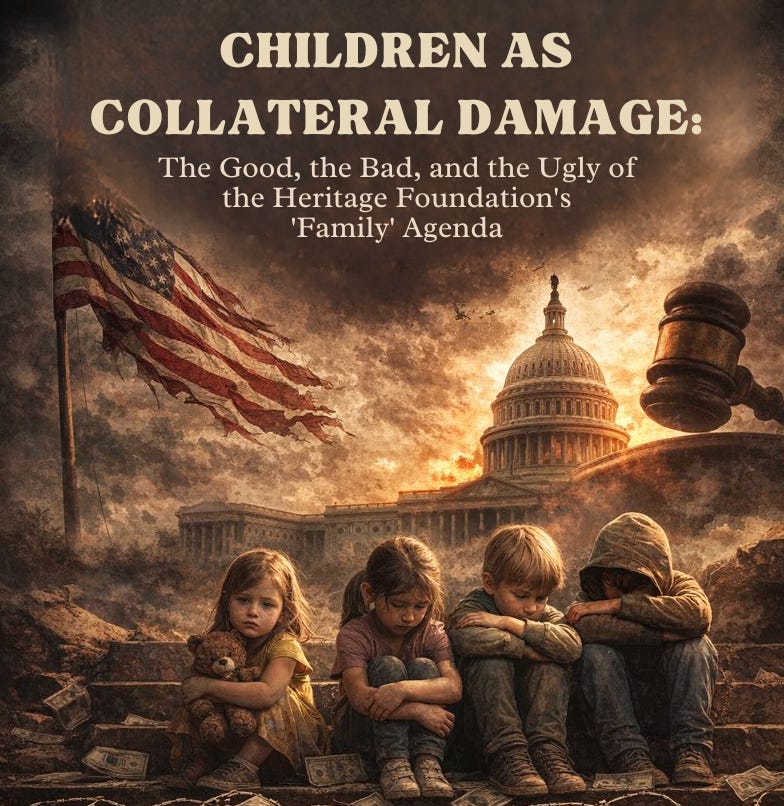
From its opening pages, the report asserts that contemporary American culture has inverted its priorities – placing adult desires above children’s needs – and that this inversion threatens both children’s well-being and the nation’s future. The six co-authors write:
...all children have a right to the affection and protection of the man and woman who created them...the default in American culture today is to put the desires of adults over the needs of children.[1]
This framing matters. Heritage is not simply proposing tax credits or regulatory changes. It is attempting to claim moral high ground – asserting that children are owed something by society, that public policy has failed to honor that obligation, and that a fundamental reordering of federal priorities is required to set things right.
On its face, this is a claim many child advocates would agree with: children’s needs should come first. Frankly, children’s needs have too often been ignored in policymaking, and fragmented systems frequently fail families. Government decisions across health, education, labor, housing, and tax policy shape family life in powerful and often uncoordinated ways.
Where this report goes wrong is not in how it responds to the needs of children: by withdrawing support from children unless adults comply with a narrow vision of family life, and with respect to which children Heritage appears to value.
When you examine the actual policy framework Heritage proposes, a troubling pattern emerges. Children are not treated as beneficiaries or even as objects of public support. They are treated as tools or points of leverage – instruments through which government seeks to reshape adult behavior.
Support is not offered because children need it, but because adults have complied with preferred criteria related to marriage, work, sexual orientation, and citizenship. When adults do not meet the Heritage Foundation’s criteria – or when life intervenes through illness, job loss, divorce, or immigration status – children pay the price and are targeted for harm.
This is the report’s defining contradiction: it invokes children to justify a framework that systematically subordinates their well-being to an ideological project of marriage enforcement.
Heritage redefines what it means to be “pro-child” through a formula that runs throughout the report:
Pro-Marriage + Pro-Child = Pro-Family[2]
This equation attempts to transform children from rights-holders into policy instruments. Children’s interests are no longer evaluated independently – through measures like health, safety, development, or economic security. Instead, they are evaluated through adult compliance with an idealized model of family life.
Under this framework, policies that materially improve children’s lives can be rejected if they don’t also reinforce marriage. More damaging, policies that restrict support or impose hardship on children can perversely be described as “pro-child” by Heritage if they are believed to influence adult behavior in the desired direction.
Child well-being is no longer the goal of public policy. Instead, children are nothing more than a tool to use toward another ideological objection.
There is a striking irony here. Heritage has long positioned itself against government “social engineering” or attempts to use policy to reshape behavior, culture, and social arrangements according to elite preferences. Yet Saving America by Saving the Family proposes exactly that: a sweeping effort to use federal power to engineer a specific vision of family life, with children serving as the pressure point.
This conditional framework extends beyond marriage and work to include immigration status, with especially troubling implications. Under Heritage’s recommendations, access to key family benefits would be denied not only to undocumented parents but also to U.S. citizen children living in mixed-status families.[3] A child’s eligibility for support is determined not by their own citizenship or developmental needs, but by the legal status of their parents.
This departs from a long-standing principle in child policy, the Constitution, and Supreme Court decisions: that children should not be punished for circumstances beyond their control.[4]
In their paper, the Heritage Foundation authors reject that principle outright and, in doing so, create what can only be described as a hierarchy of deservingness in which some children are deemed less worthy of protection and investment than others based on their parents’ actions or status.
Because Heritage claims to put children first, this response evaluates its proposals on exactly those terms. Does the framework actually improve children’s health, safety, development, and economic security, especially for children facing the greatest vulnerability? Or does it use children as leverage to enforce adult compliance?
The sections that follow take Heritage at its word by measuring its policy recommendations against what decades of research tell us about children’s needs, and by examining the internal contradictions that arise when child-focused evidence collides with marriage-enforcement ideology.
If children truly come first, policy must be judged by how it treats them – not by how effectively it pressures adults.
The Child Tax Credit Contradiction: When Babies Don’t Matter
One of the clearest illustrations of Heritage’s failure to put children first can be found at the very beginning of life, or how the report treats newborns and infants.
Consider a child born to a mother who experiences a loss of income during pregnancy or after childbirth. This is not a hypothetical scenario, as it is a common occurrence given the lack of universal paid leave, pregnancy-related health complications, and the caregiving demands of early infancy.
Yet under current law, this income loss can result in the child receiving only a partial Child Tax Credit or no credit at all, because eligibility is tied to parental earnings rather than to the child’s needs.
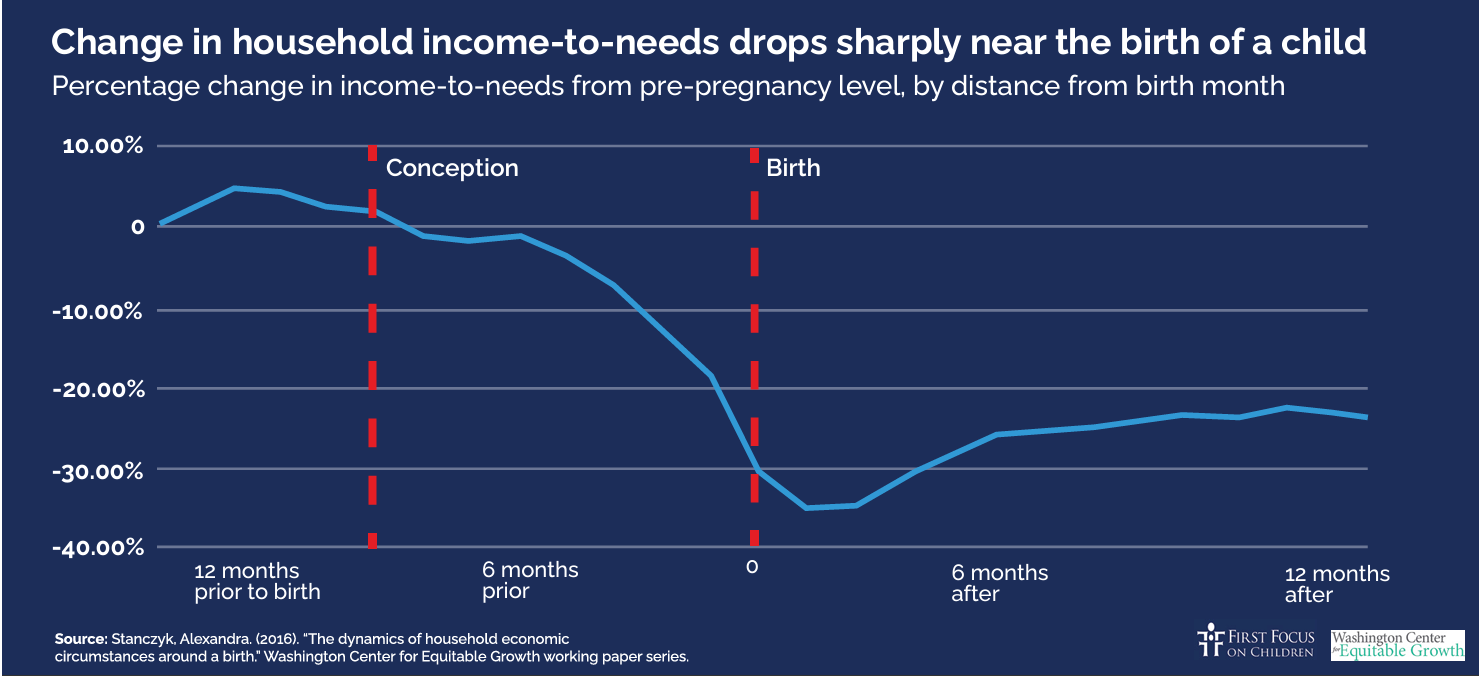

Heritage acknowledges this flaw. The report correctly identifies that the current Child Tax Credit is “biased toward low-income small families” and notes structural problems with how the credit operates.[5] In other words, Heritage knows the current structure harms babies.
From a child development perspective, this is precisely backward. Infancy and early childhood are the periods when:
Children are most vulnerable and income stability matters most
Early investments have the highest returns (Heritage acknowledges this on page 31)
Parental stress and economic instability have lasting developmental consequences
Heritage even quotes research showing that “family-friendly policies like parental leave can help to support early development by allowing parents to spend critical time with infants,”[6] and emphasizes that “early investments in children have high returns” while “remediating skill gaps in adolescence is often less effective.”[7]
Then They Defend the Flaw
Having recognized this problem, one might expect Heritage to propose a solution: ensuring that babies receive full support regardless of temporary fluctuations in parental earnings. Instead, the report does something rather disturbing, which is to defend keeping the flaw in place.
For example, after acknowledging that the Child Tax Credit’s current policy of limited refundability punishes families with children, the report rejects fixing the problem. The paper argues:
…eliminating that bias in the CTC would fundamentally change the nature of the credit, making it more akin to a guaranteed basic income that would discourage work.[8]
In short, adherence to their ideological commitment to work requirements causes them to support policy structures that harm newborns and infants, particularly those most in need.
This is not a marginal policy choice. It is a profound statement about priorities. When forced to choose between supporting vulnerable babies and enforcing their ideological position on adult work incentives, Heritage chooses the latter and yet calls it “pro-child.”
It isn’t.
Who Gets Left Behind
Consider the real children affected by this decision:
Children who have a parent dies or becomes ill — family income drops and results in partial or no CTC
Children and families who are victims of a natural disaster — when income drops, harm is compounded due to the potential decrease or loss of the CTC
A baby whose mother experiences pregnancy complications — income drops postpartum, which results in partial or no CTC
Children in a family experiencing job loss — unemployment results in partial or no CTC
Children whose parent chooses to provide care at home — income drops during caregiving, which can also lead to partial or no CTC
The children who experience these “child and baby penalties” do not experience them as “policy nuance” or “work incentives.” They experience it as:
Reduced household resources during the most critical developmental period
Increased parental stress at precisely the moment stability matters most
Delayed access to basic needs: nutrition, housing stability, health care
Heritage’s position is akin to a lifeguard who only rescues swimmers who can prove they took swimming lessons, are wearing Coast Guard-approved flotation devices, and entered the water through the proper gate. Drowning swimmers who jumped in from the wrong spot, or whose lessons expired, or who couldn’t afford the approved equipment, are left to struggle or even drown. The lifeguard isn’t neutral: they’re withholding rescue to “teach” people proper pool behavior.
That’s not lifeguarding. That’s conditional rescue. And children experiencing poverty, instability, or hardship during critical developmental windows aren’t “learning lessons” from withheld support – they’re drowning in real time, with consequences that last a lifetime.
A framework that claims to value babies but tolerates – indeed, defends – leaving newborns behind in this way is certainly not pro-child. Nor is it pro-family. To quote the Heritage paper:
To be pro-family, a policy must do more than merely lead, or be designed to lead, to more babies.[9]
Not so much.
Other Internal Contradictions Exposed
This is not simply a policy disagreement. It is an internal contradiction that runs through the entire report.
Heritage repeatedly emphasizes that:
“Early investments in children have high returns”[10]
“Early gains compound over time, whereas remediating skill gaps in adolescence is often less effective”[11]
“Family-friendly policies like parental leave can thus help to support early development by allowing parents to spent critical time with infants or to secure enriching care environments”[12]
Yet their policy choice ensures that babies facing economic stress – the children who would benefit most from stable support – are the ones most likely to be denied it.
This is not an oversight. It is organized abandonment: a deliberate policy choice to withdraw support at the moment when children are most vulnerable, because protecting them would conflict with imposing work requirements on adults.
When Heritage says children come first, they actually mean children come after work incentives, after marriage enforcement, and after ideological purity.
That is not child-centered policy. That is children as collateral damage.
Marriage Penalties and the Whole-of-Government Divergence
Heritage’s call for a “whole-of-government” approach deserves particular scrutiny – not because coordination is wrong, but because Heritage wants to coordinate around the wrong goals.
Heritage’s Vision: Marriage Enforcement as Federal Priority
The report calls for sweeping executive action to reorient the entire federal government around marriage promotion. The report proposes:
The President should issue a series of executive orders requiring every grant, contract, policy, regulation, research project, and enforcement action involving the federal government to...explicitly measure how it helps or harms marriage and family, block actions that discriminate against family formation, and give preference to actions that support American families.[13]
This creates a government-wide system for:
Measuring whether policies increase marriage rates
Blocking policies that don’t promote their vision of family
Giving preference to policies that reward conformity
The report even proposes specific implementation mechanisms, including “Family Formation and Social Capital Strategy” frameworks and requirements that agencies include family impact assessments in their research and grant-making.[14]
Heritage is right about one thing: fragmented policy fails children. Government decisions across health, education, housing, labor, and social services shape family life in powerful ways – often without coordination.
But coordination toward the wrong goal does not produce better outcomes for children.
The Alternative: A Child-Centered Whole-of-Government
Instead, a child-centered whole-of-government approach would ask federal agencies to measure whether policies improve:
Children’s physical and mental health
Early learning and educational opportunity
Safety from harm and exposure to trauma
Economic security and housing stability
Developmental outcomes and well-being
In this framework, coordination is not about enforcing family form. It is about building and aligning child caregiving and support systems to improve health care, nutrition, child care, early education, income supports, housing, and child protection so they function together rather than at cross-purposes.
Child-serving systems and programs with the word “Child” in them (such as the Child Tax Credit) should always put the needs, concerns, and best interests of children first – not based on family structure and their parents’ status.
The contrast could not be starker:
A child-centered approach measures success by whether children are healthier, safer, and better supported. Heritage emphasizes support for children in traditional families, while leaving all others behind.
Heritage’s Social Engineering Through Child Policy
At this point, it’s worth highlighting that the Heritage Foundation’s agenda is one that is textbook social engineering – using policy to manufacture preferred social outcomes.
Heritage has historically opposed such efforts when aimed at different goals: diversity initiatives, environmental behavior change, public health interventions, etc. Their past critique is familiar: government shouldn’t be in the business of manipulating behavior through carrots and sticks, of using policy to enforce cultural preferences.
Yet that is precisely what Heritage proposes here. The framework doesn’t simply “remove obstacles” or “stop punishing families.” It actively conditions children’s access to support on adult compliance with behavioral expectations. It uses marriage penalties and work requirements not as unfortunate side effects, but as design features intended to make certain choices economically rational and others economically punishing.
The tool of social engineering is children themselves. When a baby loses access to the Child Tax Credit because a parent experienced income loss, that’s not neutral policy. It’s behavioral conditioning – using a child’s hardship to signal that certain life choices carry costs. When U.S. citizen children in mixed-status families are denied support, that’s not simply immigration enforcement. It’s using children’s material well-being as a lever to influence family composition and adult status.
This matters because social engineering through child policy is particularly cruel. Adults can, in theory, modify their behavior in response to incentives. Children cannot. They absorb the consequences of adults’ failure to comply – experiencing those consequences developmentally, during windows that shape their entire lives.[15]
So yes, this is social engineering. But unlike engineering, which attempts to change adults directly, Heritage’s framework engineers adult behavior by making children pay for noncompliance.
To be clear: aligning systems to improve children’s outcomes – their health, education, development, safety, economic security, and well-being – is fundamentally different from conditioning support to engineer adult behavior. The former responds to need; the latter manufactures compliance. Heritage’s framework does the latter while claiming to do the former.
Acknowledging Harm, Then Intensifying It
Shockingly, Heritage correctly identifies that existing welfare and tax policies impose “marriage penalties” that disadvantage single-parent households.[16] This acknowledgment confirms what decades of child policy research have shown: current structures already harm children in families that don’t conform to a married, two-parent ideal.
But rather than fixing these penalties to help children, Heritage proposes to expand and formalize them by explicitly adding conditions of support based on marriage, work status, and citizenship. The framework doesn’t accidentally exclude children in non-conforming families. It excludes them by design.
Three New Proposals of Organized Abandonment
The Family and Marriage (FAM) Tax Credit
Heritage proposes a new refundable tax credit of up to $17,670 per child – the same maximum as the current adoption tax credit. But eligibility requires that parents be married, maintain that marriage for at least four years, meet work requirements, and have at least one parent who is a U.S. citizen.[17]
Children explicitly excluded:
Children of unmarried parents
Children whose parents divorce within the four-year period of the credits payout
U.S. citizen children in mixed-status families
Children in families experiencing work disruption
Home Childcare Equalization (But Only for Married Couples)
Heritage notes that “federal policies explicitly support only one option” when it comes to childcare – paid formal care – and proposes a “Home Childcare Equalization (HCE) Credit” for families who choose at-home care.[18]
However, when you read the fine print, the credit is only available to married families who also qualify for the FAM credit, which requires both marriage and earnings of at least $30,470.
Left behind are the children of single parents and low-income families who need the support the most.
Newlywed Early Starters Trust (NEST) Accounts
These accounts would be “seeded with at least $2,500 upon the birth of a child where at least one of the parents is a U.S. citizen.” Withdraws would “not be allowed” from these Newlywed Early Starters Trust (NEST) accounts until the person marries or turns 30. However, once the beneficiary turns 30, they can withdraw the funds, but they will face a tax penalty. If someone marries, withdraws funds tax-free, and then gets divorced, they are taxed on future withdrawals.
The intent is to financially incentivize not only marriage but also early marriage.
Who Bears the Cost
When policies withdraw support from families that don’t conform to Heritage’s requirements, millions of children will pay the price with:
Higher child poverty rates
Increased material hardship during critical developmental periods
Greater exposure to stress and instability
Reduced access to early learning and care
Widening inequities among children
These outcomes are not speculative. They follow directly from policies that condition support on adult compliance rather than child need.
Heritage even acknowledges that “marriage has increasingly become a luxury of the affluent” and that “declines in marriage have been steepest among those without college degrees and those facing economic insecurity.”[19] In other words, Heritage knows that economic stress undermines family stability.
Yet their response is to intensify that stress for families that don’t meet ideological benchmarks—and to call it “pro-family” and “pro-child.”
It isn’t.
What ‘Whole-of-Government’ Should Actually Mean
If children truly come first, “whole-of-government” policy coordination should:
Align systems around children’s developmental needs and not adult behavior change
Prevent abandonment by ensuring no child falls through the cracks when families face stress or transition
Measure what matters to children – health, education, development, safety, stability, and well-being – not marriage rates
Heritage’s framework uses whole-of-government tools to justify withdrawal – stepping back and punishing children whose families don’t meet prescribed standards. A child-centered framework uses those same tools to ensure that every child receives the support they need to thrive.
If children truly come first, “whole-of-government” must mean whole-child.
When Safety Takes a Back Seat: The Divorce Policy Contradiction
Perhaps nowhere is Heritage’s subordination of children’s well-being to ideology more evident than in its approach to divorce.
The report states clearly that the “well-being of children should be prioritized when couples divorce.”[20] This sounds like a child-centered principle.
Yet in the same report, Heritage:
Opposes no-fault divorce[21]
Endorses making marriage “intentionally difficult to exit”
Suggests that separation should be discouraged except in “extreme cases involving immediate threats to a child’s life and safety”[22]
This framework does not prioritize children’s well-being. It subordinates children’s safety and emotional security to an ideological commitment to marital permanence.
No-fault divorce has been associated with reductions in domestic violence, female suicide, and intimate partner homicide: outcomes that directly affect children’s safety
Furthermore, the threshold of “extreme cases involving immediate threats” vastly underestimates the harm children experience in emotionally unsafe or chronically conflictual environments.
From a child protection standpoint, Heritage’s approach inverts the proper hierarchy of concerns. It treats marital permanence as a good in itself, even when maintaining the marriage may conflict with children’s immediate safety and emotional well-being.
This is not a minor philosophical difference. It has real consequences for children trapped in high-conflict households, where staying together may cause more harm than separation.
A genuinely child-centered framework would prioritize:
Safety over appearances
Emotional stability over marital permanence
Caregiving quality over household form
Heritage’s framework does the opposite by requiring children to wait for “extreme” circumstances before their well-being takes precedence over adult marital status.
Once again, children’s needs are acknowledged, only to be set aside when they conflict with ideology.
Children Should Not Be Subjected to Social Engineering
The Heritage Foundation’s Saving America by Saving the Family presents itself as a moral intervention on behalf of children. It claims to put children first, to elevate their needs above adult desires, and to restore family to its rightful place as the foundation of society.
But when examined closely – when measured against what the report’s own citations tell us about child development, and when evaluated by how its policies would actually affect vulnerable children – a very different picture emerges.
The Pattern Revealed
Across every major policy area – tax credits, welfare, early childhood support, divorce policy, immigration—the same pattern appears:
Babies lose support when parents experience income disruption
Children in mixed-status families are excluded despite being U.S. citizens
Children in single-parent households are often denied services and supports
Children in high-conflict marriages are told to wait for “extreme” danger before their safety matters
This is not accidental. It is not an unintended consequence of well-meaning policy. It is policy by design: a deliberate pattern of withdrawing collective support from children at precisely the moments when they need it most.
Conditional Childhood as Policy Should Be Rejected
At the heart of Heritage’s framework is a vision of conditional childhood: one in which children’s access to protection and opportunity depends on adult behavior, marital status, work patterns, and immigration status.
Children are not treated as rights-holders with needs of their own. They are treated as incentives: policy instruments through which government seeks to discipline adults.
Support is offered not because children need it, but because adults have earned it.
When adults fall short of the Heritage Foundation’s vision or when life intervenes through illness, job loss, caregiving demands, or family dissolution, children bear the consequences.
This is not how child-centered systems function. It is how systems shift risk downward – away from institutions and onto those least able to absorb it – BABIES AND CHILDREN.
What Putting Children First and Being Pro-Child Actually Requires
Genuinely child-centered policy requires a commitment to ensuring that children are not left behind or abandoned when families face stress, transition, or hardship.
This means:
Universal and predictable support so that children aren’t left behind when adult circumstances become complicated
Early and sustained investment during critical developmental windows—not just after families have already achieved stability
Safety over appearances, and caregiving quality over household form
Refusing to sort children by deservingness based on parents’ marital status, income, work arrangements, or immigration status
Child development unfolds every day, shaped by whether support is present or withdrawn, whether systems respond to vulnerability or retreat from it.
Just as Heritage’s Project 2025 report was a disaster for children, so is their latest proposal. It should be soundly rejected.
Instead, public policy should meet all children and families where they are in all of their various forms with care, support, stability, and the full measure of our collective commitment.
ENDNOTES
[1] Severino, R., et al. (2026, Jan. 8). Saving America by Saving the Family: A Foundation for the Next 250 Years. Heritage Foundation. Special Report No. 323, p. 1.
[2] Ibid., p. 15.
[3] Ibid., p. 120.
[4] Stier, M. (1992, Feb.). Corruption of Blood and Equal Protection: Why the Sins of the Parents Should Not Matter. Stanford Law Review. 44:3, 727-757. Stier references the Constitution’s Corruption of Blood Clause, the Bill of Attainder Clause, and the Equal Protection Clause, as well as numerous judicial decisions preventing harm to children based on the actions or status of their parents.
[5] Severino, R., et al. (2026, Jan. 8)., p. 117.
[6] Ibid., p. 30.
[7] Ibid., p. 31.
[8] Ibid., p. 117.
[9] Ibid., p. 15.
[10] Ibid., p. 31.
[11] Ibid., p. 31.
[12] Ibid., p. 30.
[13] Ibid., p. 8.
[14] Ibid., pp. 97-103.
[15] Stier, M. (1992, Feb.)
[16] Severino, R., et al. (2026, Jan. 8), pp. 103-107. In a section titled “Federal Marriage Benefits: The Legal Privilege of Matrimony,” the report acknowledges that “billions of dollars in preferential treatment based solely on marital status” are awarded to married couples.
[17] Ibid., pp. 119-121.
[18] Ibid., pp. 122-123.
[19] Ibid., pp. 76-77.
[20] Ibid., p. 49.
[21] Ibid., p. 47.
[22] Ibid., p. 131.