


Breaking News Update:

After I published my newsletter yesterday, a federal judge issued a temporary injunction against the most recent Trump Executive Order on birthright citizenship later that afternoon. However, the Administration will undoubtedly appeal the decision, so this debate will continue.
*****
The Trump Administration is, according to Reuters, drafting new passport guidance that would require parents to prove their own citizenship or immigration status before their U.S.-born child can receive a passport. This is intended to open a new opportunity for the Administration to question the citizenship status of children.
Right now, a child applying for a passport must provide evidence of the child’s own citizenship. For most children born in the United States, a certified birth certificate does the job. Parents must establish their relationship to the child, present photo identification, and indicate whether they are U.S. citizens, but they generally do not have to submit documents proving their own citizenship or immigration status.
Under the draft guidance, that would change. State Department adjudicators would collect “parental information and evidence of parental citizenship or immigration status” to determine whether a child is covered by President Trump’s August 6 Executive Order targeting so-called “birth tourism” and attempting to create new exceptions to birthright citizenship.
This is the latest salvo in the Administration’s relentless assault on the citizenship status of children. The Administration’s latest Executive Order attempts to condition a U.S.-born child’s constitutional citizenship on some sort of audit of their parents’ paperwork. Once again, this is at odds with the Citizenship Clause in the Constitution, as the Supreme Court recently reaffirmed in Trump v. Barbara. It is yet another example of the Administration’s endless policy proposals that negatively impact children.
Reuters reports that the proposed guidance would apply to every child seeking a passport in this country and not merely to families suspected of fraud or other wrongdoing. Parents and guardians would be required to produce documents such as a valid U.S. passport, birth certificate, I-94 immigration record, or permanent resident card so the State Department could investigate whether the child qualifies for a passport under the new order.
That is a remarkable inversion of the current process, the Supreme Court’s recent decision affirming birthright citizenship, and over 100 years of federal law, administrative rule and practice.
The child’s birth on U.S. soil would no longer necessarily settle the question of citizenship for the Administration. The government would look behind the child’s own evidence of citizenship and investigate the adults responsible for submitting the application. The Administration’s goal is to create a loophole in which a child’s birth does not automatically convey citizenship under the guise of trying to stop “birth tourism” or “fraud”.
However, if the goal were simply to investigate specific evidence of “birth tourism,” fraud, or determine whether a parent possessed diplomatic immunity, the State Department could examine those cases individually. Instead, the Administration is seeking to require every child seeking a passport in America to go through a brand-new parental-status checkpoint. This would place each and every child’s citizenship documentation under potential suspicion and question.
The Constitution Doesn’t Have a Parental-Paperwork Clause
Despite the Administration’s repeated attacks on birthright citizenship, the Constitution’s Citizenship Clause explicitly confers birthright citizenship on all children born in this country and who are subject to its laws.
That alone should have ended the Administration’s effort to make a child’s citizenship depend on a parent’s immigration status.
Instead, the Administration has returned with a narrower Executive Order in one respect but with a far different and broader documentation system at the State Department. The proposed passport guidance would require every family applying for a child to produce evidence about the parents, so that the government can decide whether the child falls within one of the new exceptions the President has attempted to create.
This new order is also broader in another way: unlike the original order, which applied only to children born after a specific date going forward, this one seems to be retroactive — which is why advocates have already asked a federal court to block the Administration from applying it to children who were born before the order was signed.
Furthermore, the Administration is trying to invent new conditions of citizenship for children that the Constitution does not contain. Although the Supreme Court has recognized a narrow historical exception for the U.S.-born children of foreign diplomats who possess immunity from American law, the new Executive Order goes considerably further. It expands the exception to include any parent who works at a foreign consulate or embassy, not just ambassadors and people with diplomatic immunity. It attempts to exclude children based on a parent’s alleged involvement in a surrogacy arrangement, another “commercial transaction,” or fraud.
The Constitution does not hold a child responsible for the status, circumstances, political views, or actions of their parents. It grants children birthright citizenship. Full stop.
Who Actually Gets Hurt
On paper, the proposed documentation requirement would apply to every family seeking a passport for a child. In practice, it would not burden every family equally. This is the quiet cruelty of the design.
A parent with a valid U.S. passport can make another photocopy and move on.
A naturalized citizen might have to locate documents issued years or decades ago. A parent whose lawful immigration status is being extended, reviewed, or corrected could face delays and uncertainty. A parent without legal status may reasonably fear that submitting immigration information to a federal agency will expose the entire family to enforcement.
The government knows this.
A parent without legal status may be unwilling to walk into a passport office and hand over information about their immigration history, even to obtain a passport that their citizen child is legally entitled to receive.
Whether that chilling effect is the policy’s formal purpose or merely its entirely foreseeable result, the consequence will be the same: some citizen children will never receive passports because their parents are afraid that applying will expose their families to immigration enforcement.
Denial by decision and denial by deterrence arrive through different doors. The child is left outside either way.
A formally universal paperwork requirement can therefore produce profoundly unequal results. The government would make every child pass through a parental-status checkpoint while knowing which children are most likely to be stopped there.
Children do not choose their parents’ immigration status. They do not choose where they are born. Birthright citizenship exists precisely so that a child’s legal standing in this country is not held hostage to a parent’s nationality, status, or circumstances. Birthright citizenship exists to protect children from statelessness, exclusion, exploitation, and the creation of a hereditary caste system.
A Status Check Only Children Will Ever Face
There is another inequality at the center of the proposal.
Adults born in the United States do not have to prove their parents’ citizenship or immigration status when they apply for or renew their passports. They establish their own citizenship through their own birth certificates, previous passports, or other accepted records. In effect, adults will not be affected.
Instead, the proposed guidance would only target children.
This burden is especially consequential for children because they cannot apply on their own. They cannot retrieve their parents’ records, explain discrepancies in immigration databases, challenge an official’s suspicion, or decide whether the family can safely disclose information to the federal government.
By definition, children depend on adults to exercise a right that belongs to the children themselves. That dependency becomes the mechanism through which the government is threatening the status of babies and children.
The Administration is purposefully exploiting the legal dependency of childhood to make a child’s access to citizenship documentation contingent on information about their parents. No adult citizen born in America will ever be required to prove that their parents were legally present when they were born, but every child would have to do so if the Administration has its way.
The Impossible Paperwork Problem for Some Children
Even setting aside the constitutional questions, consider how children would be expected to comply with this new system.
A child in foster care is more likely to have birth parents who are absent, unreachable, incarcerated, or the reason the child was removed from the home. The existing passport process permits foster-care agencies and legal guardians to use court orders and other records to establish their authority to apply. But would those documents also relieve the agency of an obligation to establish the absent birth parents’ citizenship or immigration status?
The reported guidance does not yet give the public an answer.
A child fleeing a violent household, or living with one parent who has cut off contact with an abusive partner, may have no safe means of obtaining the other parent’s immigration documents. A protective order may exist precisely to prevent the contact that the passport process could effectively require.
A child with a parent in jail or prison may have no practical way to retrieve records controlled by that parent.
A child being raised by a grandparent or another relative may have little or no contact with either biological parent, much less access to their passports, naturalization certificates, immigration forms, or records of their legal status at the time of the child’s birth.
The existing passport system contains alternatives for families in which both parents cannot appear. Depending on the circumstances, families can submit custody orders, death certificates, foster-care guardianship documents, incarceration records, restraining orders, or statements describing special family circumstances.
But those procedures were designed primarily to establish parental consent and protect against international child abduction. They were not designed to reconstruct the citizenship and immigration history of every absent parent.
These circumstances describe millions of American children living in ordinary, completely legal family arrangements, yet their citizenship status could be threatened by the Administration’s new policies.
Babies Do Not Sign Surrogacy Contracts
The Executive Order’s treatment of surrogacy is particularly troubling, as it targets certain children born through surrogacy, potentially making a child’s citizenship depend on how adults arranged and financed the pregnancy.
That raises questions extending far beyond immigration enforcement.
Which parent’s citizenship or intent controls? How would the State Department treat an American surrogate carrying a child for intended parents from another country? What happens when a state court has entered a pre-birth or post-birth order recognizing the intended parents? Can the executive branch create a disfavored constitutional category of children based on a lawful reproductive arrangement entered into before they were born?
Most important, why should any of those adult decisions diminish the status of the child?
A baby does not negotiate a surrogacy agreement. A baby does not select the adults involved, determine how they are compensated, or choose the jurisdiction in which a contract is signed.
Yet the Executive Order proposes to attach constitutional consequences to the baby because of it. Again, it defies the Constitution’s very clear birthright citizenship clause, which is a fundamental child right.
A Passport Is Not a Citizenship Permission Slip, but Is Important
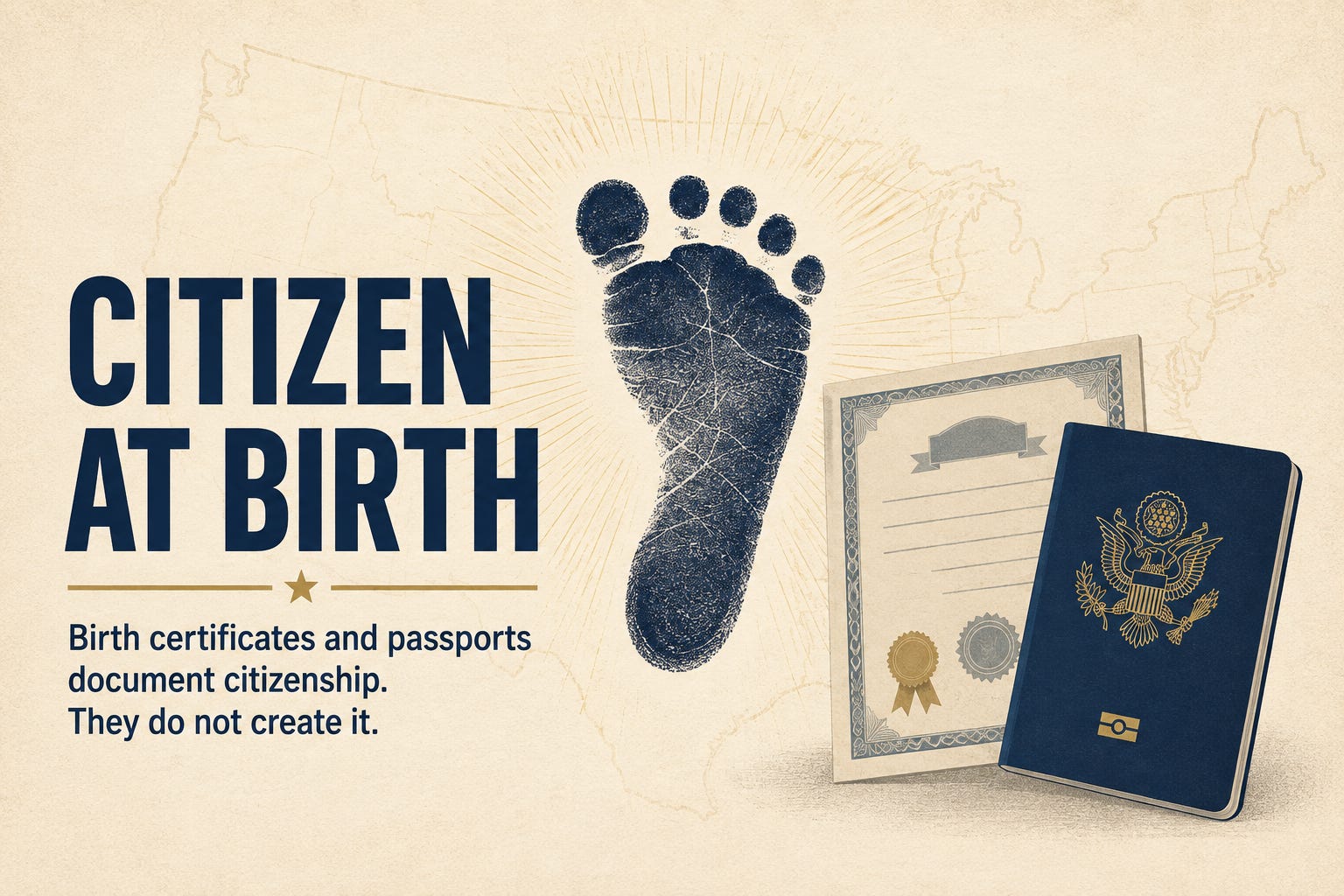
A passport does not create citizenship. Instead, a passport provides proof of citizenship. The Constitution’s birthright citizenship clause and federal law are what decide citizenship.
A passport is important because it allows people to travel and is, like a birth certificate, one of the clearest and most durable pieces of evidence or documentation of their citizenship.
That is why placing an unconstitutional condition inside the passport process can do enormous harm even if the government stops short of formally “revoking” a child’s citizenship.
What Happens Next
The proposed State Department guidance has not been finalized, and the Administration’s latest Executive Order is already headed toward another court fight.
Lawyers representing babies who would have been deprived of citizenship under Trump’s original order have asked federal judges to prevent the August 6 order from taking effect. In Maryland, U.S. District Judge Deborah Boardman declined to block it immediately because the plaintiffs’ existing complaint did not yet challenge the new order. But she allowed them to amend their case and established an expedited schedule.
She also reportedly questioned where the Supreme Court’s ruling recognized an exception to birthright citizenship for “birth tourism.”
The Justice Department has so far relied in part on a procedural shield. It argues that judicial intervention is premature because federal agencies have not finished explaining how the new order will be implemented.
The Administration cannot have it both ways. It cannot order agencies to stop recognizing some children as citizens while asking courts to look away until the administrative machinery is fully assembled.
The State Department should release the complete proposed guidance. Congress should demand answers about how this process would even work. The Administration should have to explain why it is, once again, targeting children for harm.
Hopefully the courts will reject it, once again.
Citizenship Is Not Provisional
The proposed passport policy reveals a recurring form of governmental blindness to childhood. It treats children not as citizens possessing rights of their own, but as extensions of adults whose status, conduct, employment, and paperwork can be imputed to them.
Children do not choose their parents’ immigration status. They do not negotiate surrogacy agreements, take foreign-government jobs, arrange where they will be born, or maintain the family filing cabinet.
Yet it is their citizenship documentation that the government proposes to withhold.
The Administration seems to lack the understanding that a birth certificate merely documents citizenship, and a passport simply confirms it. For children born on U.S. soil and subject to U.S. jurisdiction, citizenship arises at birth under the Constitution.
On that point, the Fourteenth Amendment rejected the idea that American citizenship should descend only through favored bloodlines or parents whom the government considers worthy. After the Supreme Court reaffirmed that principle in Trump v. Barbara, the executive branch should be implementing the decision and not searching for administrative detours around it.
A U.S.-born child’s citizenship is not provisional. It is constitutional. It does not await an audit of the parents. And the government, in the form of a passport-office counter bureaucrat, should not deny a child the documents proving their citizenship because a parent cannot, or is afraid to, produce the new paperwork the government demands.
The Trump Administration needs to stop targeting children for harm. Enough already.
It's a terrifying prospect for naturalized parents who did everything right. Even if you have your papers, the chilling effect alone is going to stop people from applying, which I assume is a feature, not a bug, of the policy.